
Darkbloom - A Private Inference Network That Matters

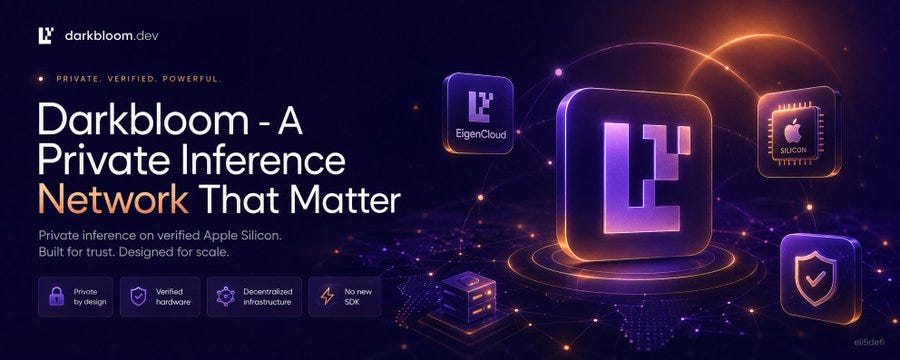
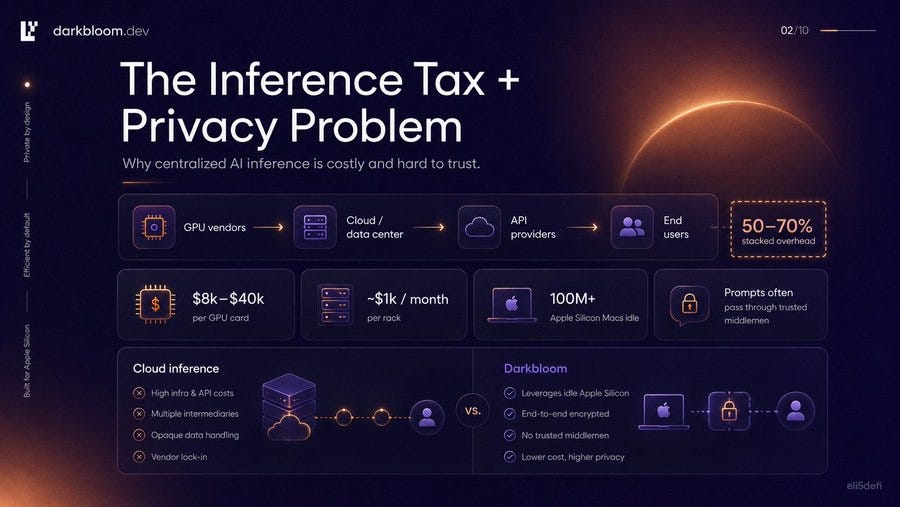
Picture this: Your MacBook Pro – the one sitting idle 18 hours a day – quietly earning you real revenue while powering frontier AI models.
Not through some vague “points” system or subsidized token farm, but with mathematically proven privacy guarantees that make centralized cloud APIs look like leaky sieves.
No data center margins. No “trust me bro” contracts.
We’ve seen countless projects promise “decentralized compute.” Most fall short on one critical axis: real privacy at scale without hardware TEEs or massive subsidies.

Darkbloom – a research preview from @eigencloud Labs (the team behind EigenLayer infrastructure) that launched in mid- April 2026 and is already live, delivering verifiable private inference on consumer Apple Silicon hardware and dubbed as the future of inference.
Let’s dive in.
The Inference Tax + Privacy Nightmare in a Centralized AI World
Traditional AI inference is economically and trust-wise broken.
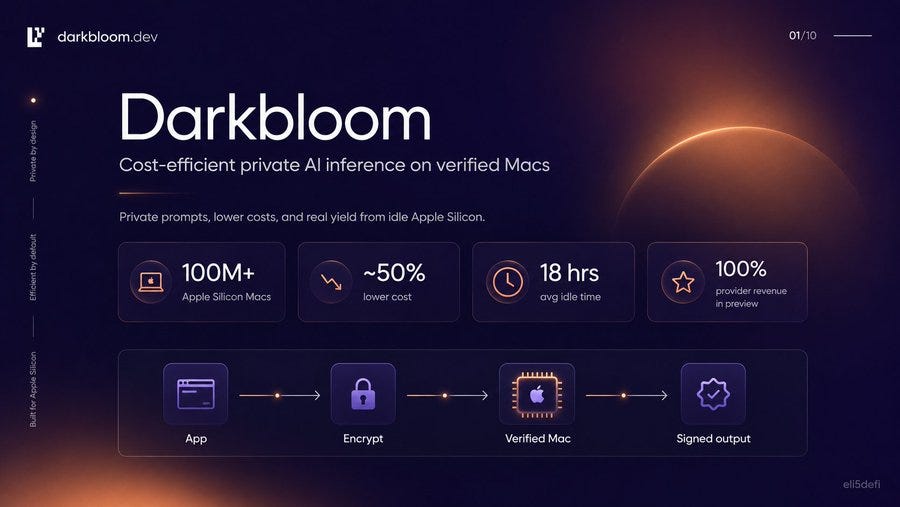
Every prompt sent to OpenAI, Anthropic, or aggregators passes through stacked overhead:
GPU capex ($8k–$40k/card)
Data center leases (~$1k/month per rack)
Power/cooling redundancy, staffing, platform fees (often 50–70%)
Meanwhile, 100M+ Apple Silicon Macs (M1–M5) shipped since 2020 sit mostly idle, yet they’re great at inference thanks to unified memory (often 24GB+, up to 128GB+), massive bandwidth, and MLX-optimized MoE models.
Net result: users overpay while global hardware is underutilized.
GPU markets are also volatile (e.g., H200 rentals spiking 29% overnight), turning inference into a commodity trade. DePIN compute networks add supply, but still inherit data-center economics and don’t offer native privacy guarantees.

As @sreeramkannan stated, Agentic systems are becoming real, “agentic companies” that own assets and transact on crypto rails. To scale, they need:
Cheap, elastic inference (kill the 50–70% “inference tax”)
Cryptographically verifiable privacy (not “trust us” contracts)
Decentralized coordination (restaking + attestation, slashable security)
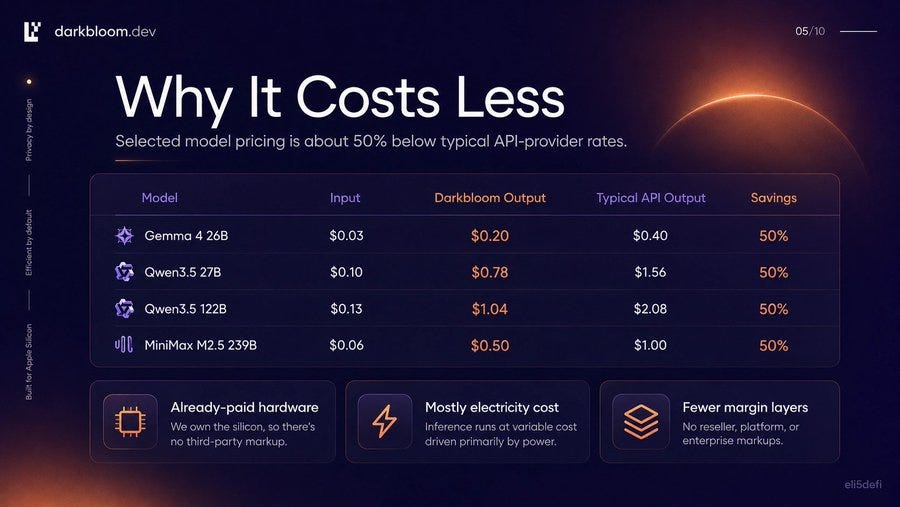
Darkbloom delivers great inference + cryptographic privacy today by using idle Apple Silicon. Providers keep 100% of revenue during preview (0% platform fee), paying mostly for electricity. Prices can be ~50% below OpenRouter (e.g., Gemma 4 26B at $0.065/$0.20 per 1M tokens in/out).
For crypto and enterprise workloads (DeFi agents, on-chain due diligence, trading signals, HIPAA-like data), centralized prompts are a non-starter. Darkbloom flips the model: the Mac owner cannot see your prompt or output, even with root access, matching or exceeding Apple’s Private Cloud Compute threat model, but on a decentralized network.
Four Layers of Verifiable Privacy Without Expensive TEEs
Darkbloom’s stack is elegantly engineered for consumer hardware (full details in the open-source repo and technical paper):
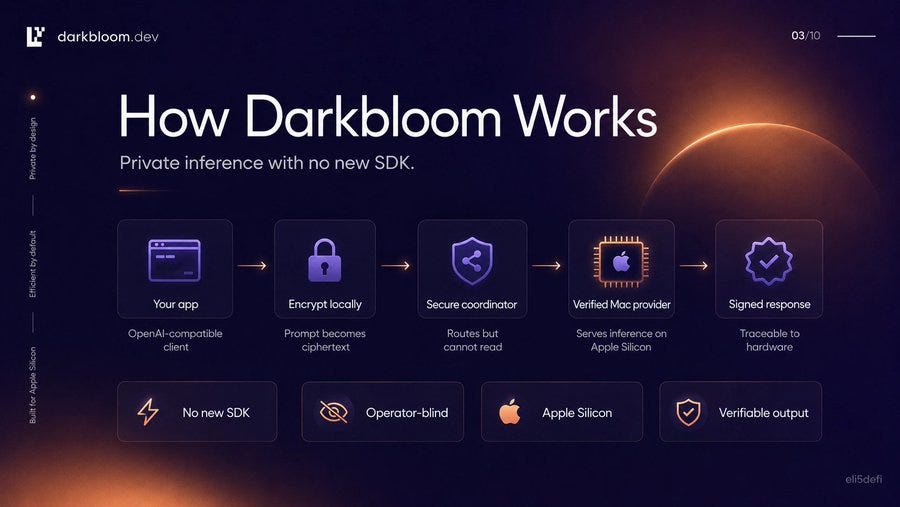
Secure Coordinator (Intel TDX TEE-backed): Routes encrypted requests only. Never sees plaintext. Handles matching, verification, and attestation
Mac Provider Agent: Hardened Rust/Swift process (latest: Swift CLI as of May 2026) embedding MLX inference engine. Runs in-process (no IPC, no subprocesses). Inference happens entirely within a locked-down environment.
Security Layer (macOS Primitives + Secure Enclave):PT_DENY_ATTACH + Hardened Runtime: Blocks debuggers and external memory reads.
System Integrity Protection (SIP): Immutable runtime; disabling requires reboot (which kills active jobs and triggers re-attestation within <5 minutes).
Apple Secure Enclave: Hardware-bound cryptographic identity for signing.4-Layer Attestation System (publicly verifiable):Layer 1: Secure Enclave P-256 signature (hardware root).
Layer 2: MDM SecurityInfo (OS-level checks).
Layer 3: Apple Managed Device Attestation (Apple-signed cert proving device authenticity).
Layer 4: Continuous 5-minute challenge-response.
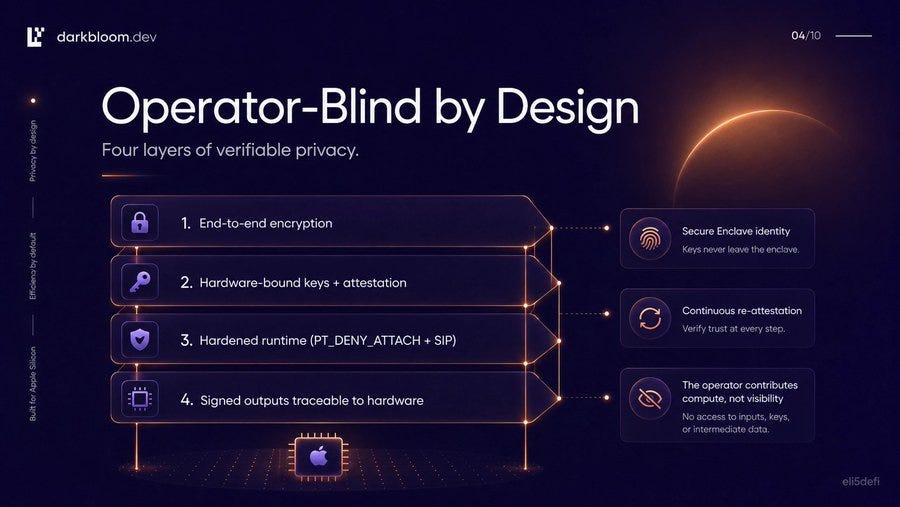
Can the Mac Owner See Your Prompt?
Answer: NO.
Four OS-level mechanisms enforce this, and they’re load-bearing together rather than individually
The residual threat left is that attacker would have to physically desolder soldered memory chips from a running Mac and read them with specialized equipment. This is the same threat model Apple uses for its Private Cloud Compute. It’s a credible upper bound on what consumer hardware can defend against.
What interesting is that Darkbloom achieves this without requiring a hardware TEE on the inference machine. Intel TDX and AMD SEV are server-class, expensive, supply-constrained. Apple Silicon Macs are everywhere.
The architectural insight is using existing macOS security primitives (designed for app sandboxing) to construct an equivalent privacy boundary on commodity hardware.I have not seen another team apply this exact combination at this depth on consumer hardware.
What This Unlocks
Privacy is the headline. The economics are a direct result of the architecture, and they make the model durable.
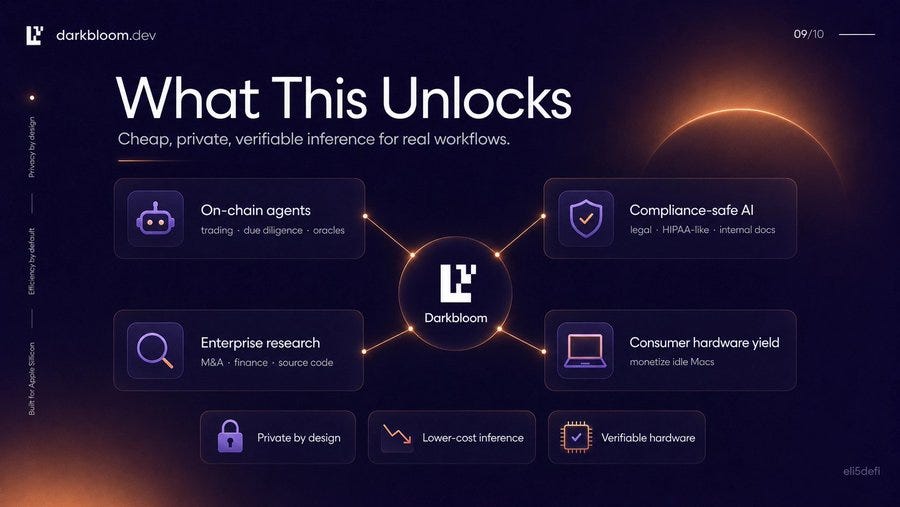
For agentic workflows, this is crucial: on-chain trading agents, DeFi oracle agents, and other sensitive systems can run inference without leaking prompts to node operators or centralized providers. Paired with EigenLayer-style restaking, you can add slashable guarantees for correctness and uptime.
Economics (Preview)
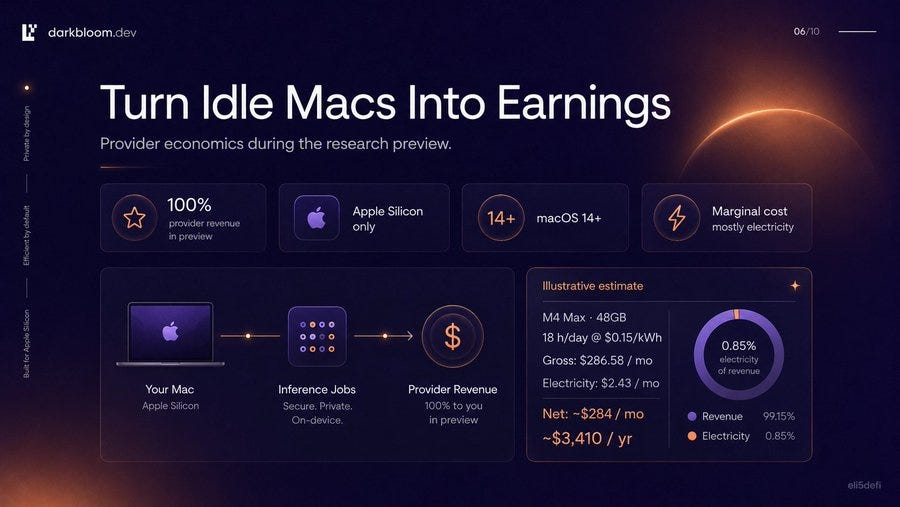
Mac providers keep 95% of token payments
Provider marginal cost is mostly electricity
Pricing is estimated ~50% cheaper than comparable cloud APIs (e.g., Qwen 27B $1.56→$0.78; Gemma 4 $0.40→$0.20; MiniMax $1.00→$0.50)
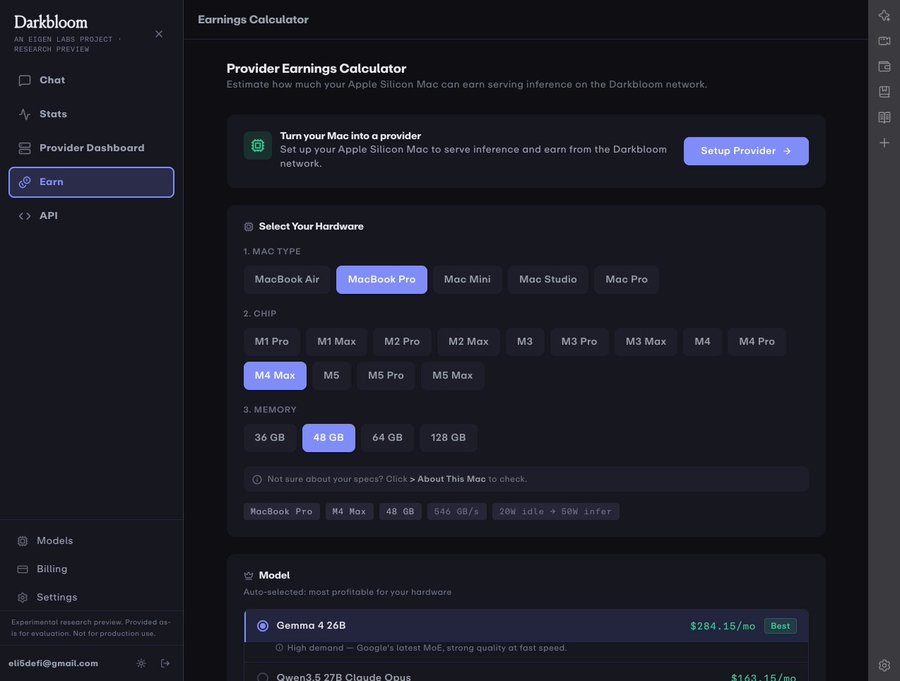
Let’s see the calculation, (MacBook Pro M4 Max, 48GB running Gemma 4 26B, 18 hrs/day @ $0.15/kWh)
Gross monthly revenue: $286.58
Electricity: $2.43 (0.8%)
Net: ~$284/month (~$3,410/year)
No subsidized beta pricing, this is what happens when you skip data centers.
What It Enables (Beyond Pricing)
Compliance-safe inference: legal privilege, HIPAA workflows, M&A research, ITAR use cases—areas avoiding AI or paying millions for on-prem
Monetizing existing hardware: ~100M Apple Silicon Macs sit idle; the missing piece was routing + verification
A better answer to “Do you see my data?”: not “trust us,” but verify the attestation chain
Darkbloom’s bet is no new hardware, unlocking CPU/GPU already in homes and offices to unlock the inference potentials.
Where the Research Preview Is Today
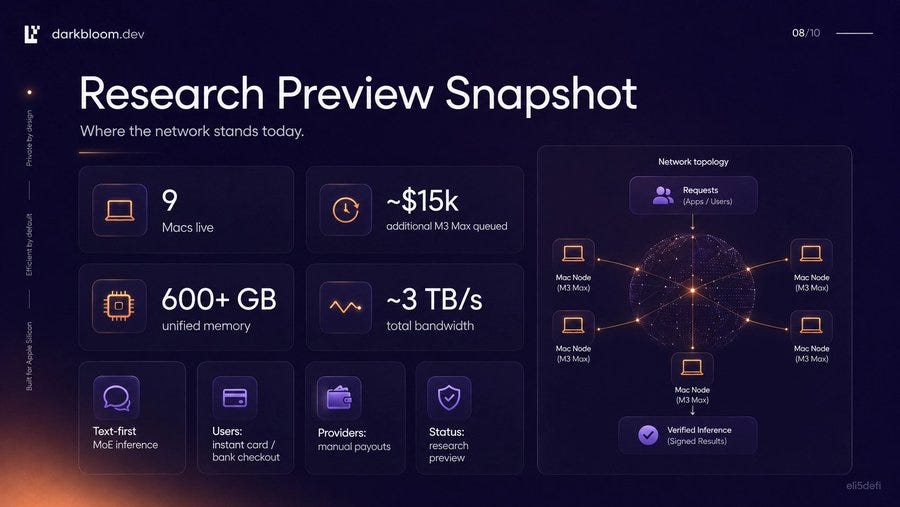
9 Macs live (~$15k compute) + $15k M3 Max queued
600+ GB unified memory total, ~3 TB/s bandwidth across devices
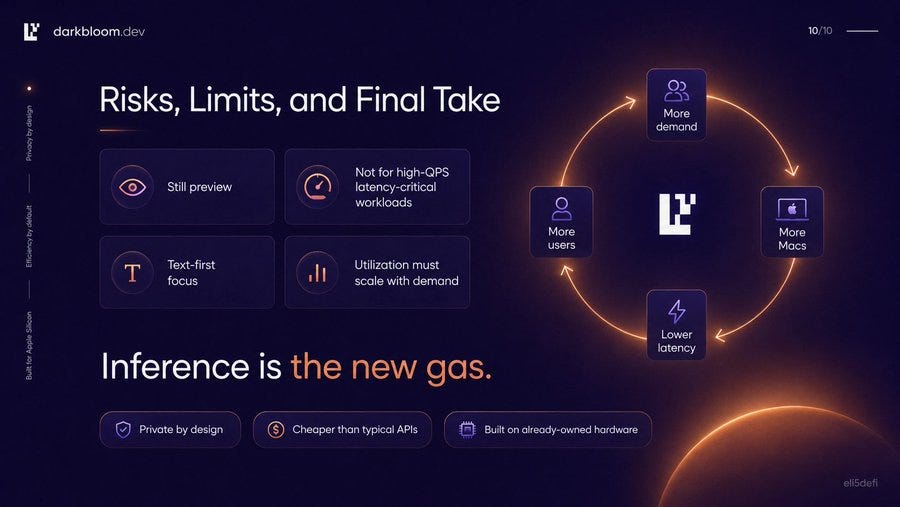
Efficient inference throughput per watt; not for high-QPS, latency-critical workloads yet but it doing well so far.
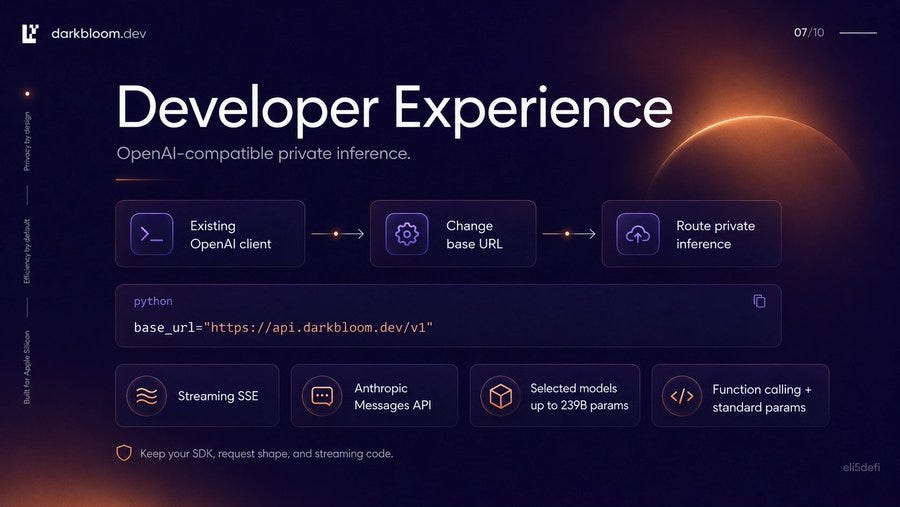
Supported modalities: Text-first (optimized MoE models). Full OpenAI-compatible + Anthropic Messages API. Streaming, function calling, and standard parameters all supported. (Image/FLUX and speech-to-text were in early preview but currently deprioritized per latest GitHub; focus remains large MoE text inference.)
Users: Instant credit card or bank (Stripe live; no waitlist).
Providers: Manual payouts (auto coming soon).
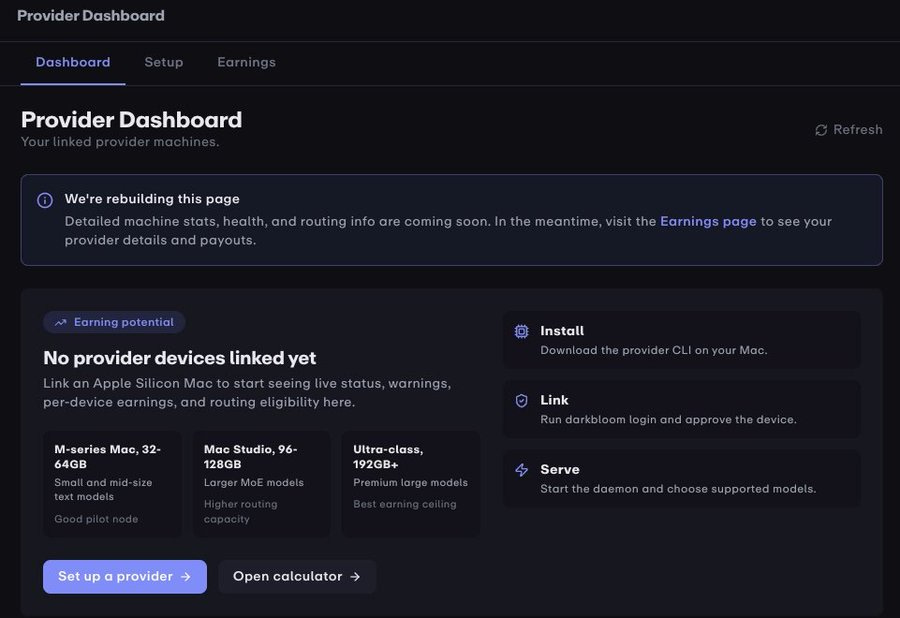
UX is still rough (it’s a preview)
Good for Right Now
Privacy-sensitive work in non-production
A/B testing vs your current provider (OpenAI-compatible API = config change)
Integration testing for compliance-focused products
Earning from idle Apple Silicon
Risks & Path to Scale (May 2026)
Still preview: Not audited. Now text-only after the Swift migration (image/STT removed). Some rough edges (e.g., model downloads).
Demand matching: 100% revenue to providers only works if user growth keeps utilization high.
Tokenization: No native token yet—aligned with Eigen’s “build first, coordinate via restaking.” Possible AVS-style node verification later.
Regulatory tailwinds: Privacy-first design fits 2026’s compliance-driven AI shift.
Bottom line: The next AI × Crypto wave isn’t speculation, it’s private, verifiable infrastructure agents can trust in production. Darkbloom isn’t chasing raw FLOPs; it’s changing the trust model and cost curve. In a world of autonomous capital, whoever solves the inference cost + privacy problem wins.
Final Take
Inference is the new gas.
Traditional GPU DePIN still pays the “inference tax.” Darkbloom cuts it at the hardware layer and adds privacy compliance teams can live with. For on-chain agents (trading, due diligence, oracles), this enables cheap, private, verifiable inference without prompt leakage or new capex.
Earning from a machine you already own is real yield on idle consumer hardware. At 800+ providers, the flywheel is straightforward: more demand → more Macs → lower latency → more users → higher utilization. DePIN without token farming or hardware subsidies—just leveraging Apple’s silicon at scale.
This is the future of AI + Consumer Hardware.
Check more details here:
Developer Site: https://www.darkbloom.dev/
Provide compute: console.darkbloom.dev/earn
Try (free credits): console.darkbloom.dev

Check My Other Channels:
Substack →
Telegram → https://t.me/eli5definews
Disclaimer: This information is for educational purposes only and does not constitute professional financial or tax advice. Some content may be developed in collaboration with third parties, and we may hold positions in the assets mentioned. We strongly recommend conducting independent research and consulting with a qualified professional before making any financial or tax-related decisions.