
Macroeconomics Indicators for Dummies


Every month, governments release dozens of numbers that quietly move your rent, your mortgage, your salary, and your job security.
Most people scroll past them. The ones who don’t have a significant advantage. These numbers are called macroeconomic indicators.
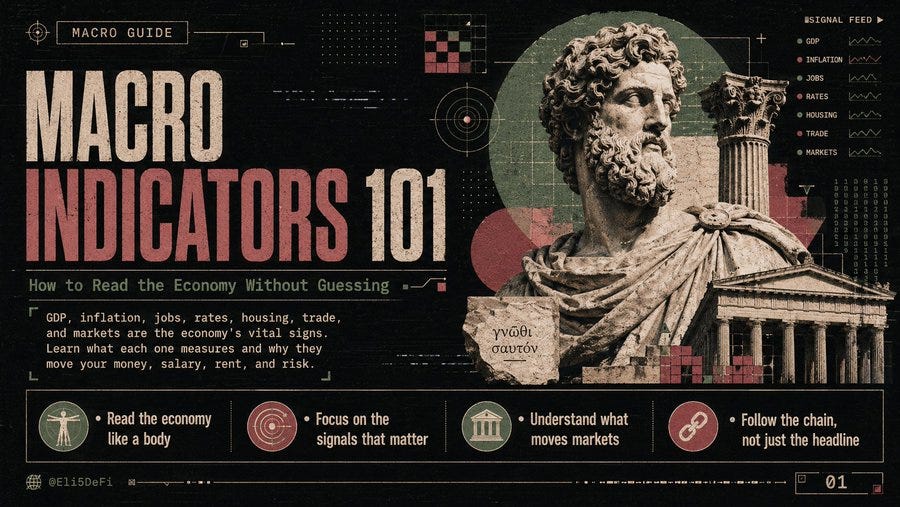
Once you understand what they’re measuring, the economy stops feeling like a black box and starts feeling like a body you can actually read.
The doctor checks your blood pressure, temperature, and heart rate, not because any one number tells the whole story, but because together they paint a picture of your health.
That’s exactly what macro indicators do for an economy.
GDP and Growth: The Annual Report Card
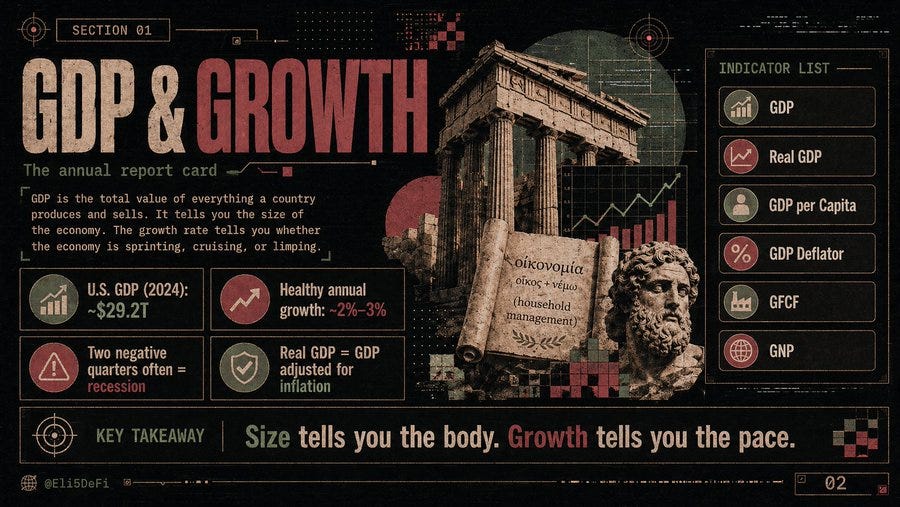
GDP is the total value of everything a country produces and sells in a year. Think of it as the economy’s annual grade.
When GDP grows at 2-3% annually, the economy gets a passing mark. Growing faster risks overheating. Shrinking for two quarters in a row is informally called a recession. The U.S. GDP sat at approximately $29.2 trillion in 2024. The number tells you size; the growth rate tells you momentum. One measures the body. The other measures whether it’s sprinting or limping.
Indicators:
GDP (Gross Domestic Product) — headline size and quarterly growth rate (annualized)
Real GDP — inflation-adjusted; the number that actually matters
GDP per Capita — output divided by population; a rough proxy for living standards
GDP Deflator — economy-wide inflation implied by the gap between nominal and real GDP
Gross Fixed Capital Formation (GFCF) — business investment in productive assets; measures how much the economy is building for tomorrow
Gross National Product (GNP) — output by a nation’s citizens regardless of location, vs. GDP’s within-borders measure
Inflation: The Grocery Receipt Test
Inflation is how fast prices are rising. The main gauge is the CPI, which tracks a basket of common goods monthly. Take your grocery receipt from this year, compare it to last year’s. That gap is inflation made personal.
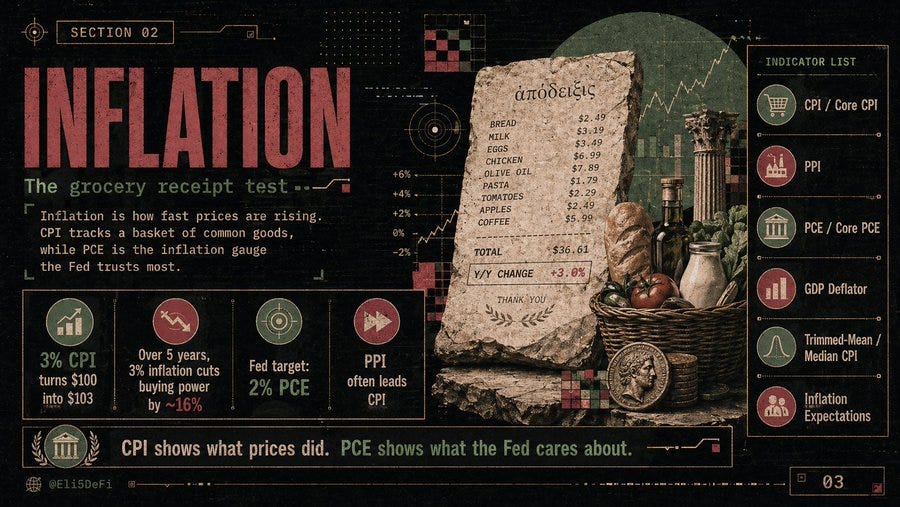
3% CPI means your $100 grocery run now costs $103. Small on paper. Compounded over five years, your money buys 16% less.
The Federal Reserve targets 2% PCE inflation — a sister measure the central bank trusts more than CPI because it adjusts for what people actually buy, not what economists assume they buy. If beef gets expensive and shoppers switch to chicken, PCE captures the substitution. CPI doesn’t.
Indicators:
CPI (Consumer Price Index) — headline (all items) and core (ex-food and energy)
PPI (Producer Price Index) — factory-gate prices; leads CPI by weeks to months
PCE Price Index / Core PCE — the Fed’s official target measure; broader coverage than CPI, lower shelter weight
GDP Deflator — broader than CPI, captures economy-wide price changes including government spending
Trimmed-Mean CPI / Median CPI — strips statistical outliers; better signal for underlying trend
Inflation Expectations — Michigan Survey (1yr and 5yr); self-fulfilling if they drift too far from the 2% target
Employment: The Economy’s Heartbeat
The labor market is where abstract economics becomes personal. Non-Farm Payrolls tells you how many jobs were added each month. The unemployment rate (4.4% in February 2026) tells you how many people are out of work and actively searching.
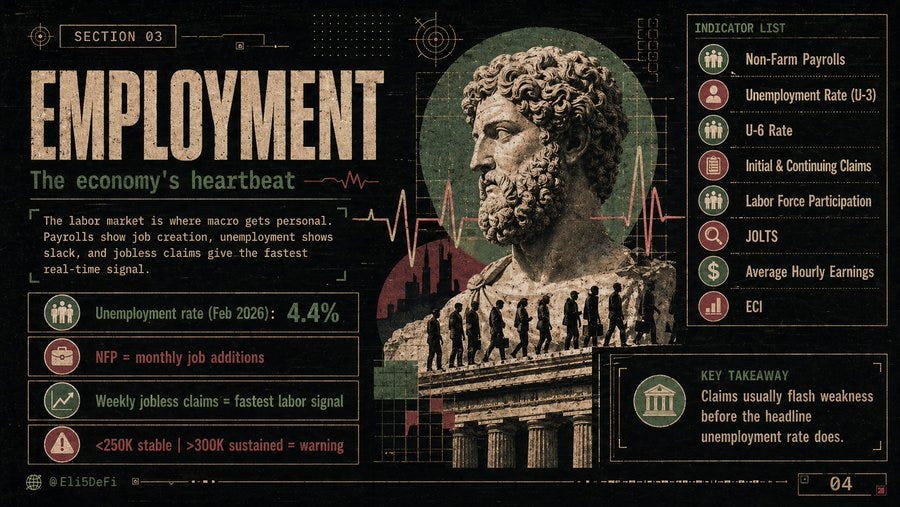
Most people miss one critical detail: unemployment is a lagging indicator. By the time the headline rate spikes, the economy has already been deteriorating for months. Companies delay layoffs hoping for a recovery.
The sharper, faster signal is weekly jobless claims, released every Thursday. Below 250,000 means stable. A sustained climb above 300,000 is when you start paying attention.
Indicators:
Non-Farm Payrolls (NFP) — monthly job additions across all non-agricultural sectors
Unemployment Rate (U-3) — jobless adults actively seeking work; the headline number
U-6 Rate — adds discouraged workers and involuntary part-timers; broader picture of labor slack
Initial Jobless Claims — weekly first-time unemployment filings; the fastest real-time read
Continuing Claims — people staying on unemployment; signals how long joblessness lasts
Labor Force Participation Rate — share of working-age adults actually in the labor force
JOLTS (Job Openings and Labor Turnover Survey) — openings, quits, and layoffs; reveals labor market dynamics, not just the stock
Average Hourly Earnings — wage growth; the bridge between employment and inflation
Employment Cost Index (ECI) — total compensation including benefits; the Fed’s preferred wage measure
Unit Labor Costs — cost to produce one unit of output; when this rises faster than productivity, inflation follows
Labor Productivity — output per hour worked; the only sustainable source of wage growth without inflation
Interest Rates and Monetary Policy: The Thermostat
The Federal Reserve sets the federal funds rate, essentially the price of borrowing money. As of early 2026, it sat at 3.50-3.75%.
Raise it, and borrowing gets expensive. Mortgages climb. Businesses shelve expansion plans. Spending cools. Inflation follows. Lower it, and credit flows, spending picks up, growth accelerates, but inflation can flare back up.
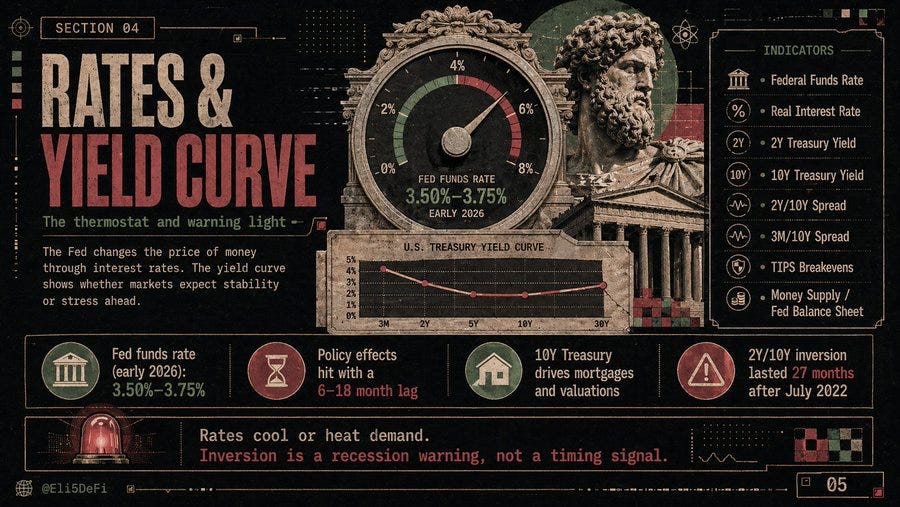
It’s a thermostat. The Fed is constantly adjusting the dial, trying to keep the economy neither too hot nor too cold. The challenge: changes take 6-18 months to fully work through the system. The Fed is steering by looking in the rearview mirror.
Indicators:
Federal Funds Rate — the overnight lending rate between banks; the master dial of U.S. monetary policy
Real Interest Rate — nominal rate minus inflation; the actual cost of borrowing after price changes
10-Year Treasury Yield — the global benchmark “risk-free” rate; drives mortgage pricing and asset valuations
2-Year Treasury Yield — more sensitive to near-term Fed expectations
Yield Curve (2yr/10yr spread) — covered separately below, but tracked here as a monetary policy output
Money Supply M1 / M2 — M1 is spendable money now; M2 adds savings and money market funds; excess growth historically precedes inflation
Fed Balance Sheet — total assets held via QE/QT; expanded to ~$9T post-COVID, reduced to ~$6.6T by end of 2025
Repo / Reverse Repo Rate — overnight plumbing operations that keep the funds rate inside its target range
The Yield Curve: The Warning Light
The yield curve compares short-term and long-term government bond interest rates. Normally, long-term rates are higher, you want more compensation for locking money up longer.
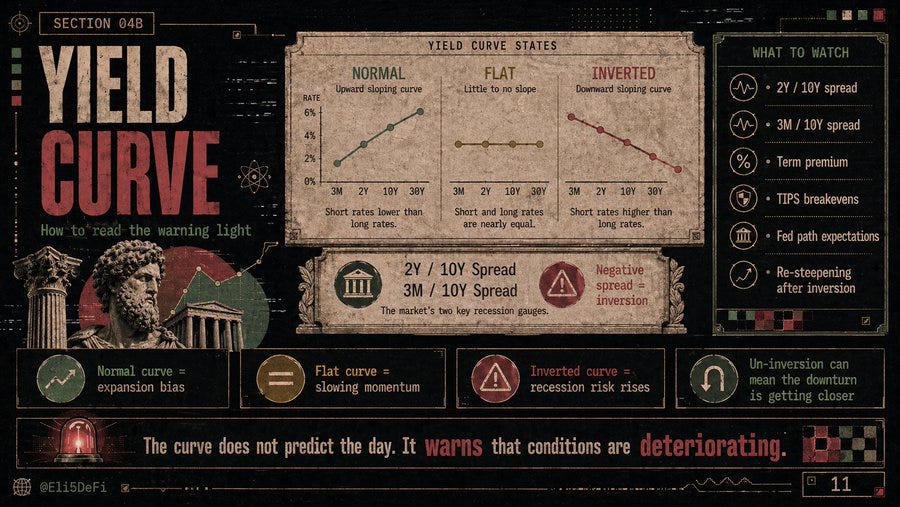
When short-term rates exceed long-term rates, the curve “inverts.” This has preceded every U.S. recession since the 1950s. The 2-year/10-year curve inverted in July 2022 and stayed inverted for a record 27 months.
Think of inversion as the check engine light on your dashboard, it doesn’t tell you exactly what’s wrong, but it tells you something is worth checking.
Indicators:
2yr/10yr Treasury Spread — the classic recession predictor; negative = inverted
3m/10yr Spread — the Fed’s preferred version; historically more reliable than 2yr/10yr
Term Premium — the extra yield investors demand for holding long-duration bonds; when it collapses, it can flatten the curve artificially
TIPS Breakevens — difference between nominal and inflation-protected Treasury yields; real-time market inflation expectations
Business and Manufacturing: What the Factory Floor is Telling You
The Purchasing Managers’ Index surveys hundreds of executives at manufacturers and service firms and asks one question: is business getting better or worse? Above 50 means expansion. Below 50 means contraction. It’s a mood ring for corporate America, released monthly, before the hard data confirms what managers already sensed.
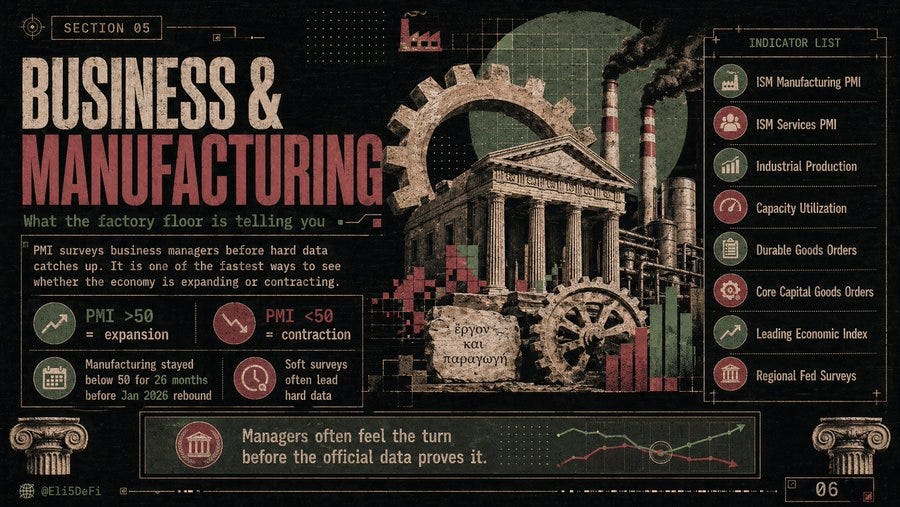
Manufacturing was below 50 for 26 consecutive months before breaking back above in January 2026. That’s nearly two and a half years of contraction in the sector that makes physical things.
Indicators:
ISM Manufacturing PMI — surveys ~400 purchasing managers across new orders, production, employment, inventories, and supplier deliveries
ISM Services PMI — same methodology for the ~90% of the economy that is services
Industrial Production — actual physical output of factories, mines, and utilities; the hard-data counterpart to PMI’s soft survey
Capacity Utilization — what share of productive capacity is in use; above ~82% signals potential bottlenecks and inflationary pressure
Durable Goods Orders — new orders for goods lasting 3+ years; volatile because of aircraft, but the core (ex-defense, ex-aircraft) is a key business investment proxy
Core Capital Goods Orders — the purest measure of business investment intentions
Conference Board Leading Economic Index (LEI) — composite of 10 forward-looking components; designed to signal turning points 6-7 months ahead
Regional Fed Manufacturing Surveys — Empire State (NY), Philadelphia Fed, Dallas Fed, Richmond Fed; released before national ISM, provide early directional reads
Consumer Activity: The Engine Room
Consumer spending drives roughly 70% of U.S. GDP. When households feel nervous, they stop spending. When they stop spending, they take the economy with them.
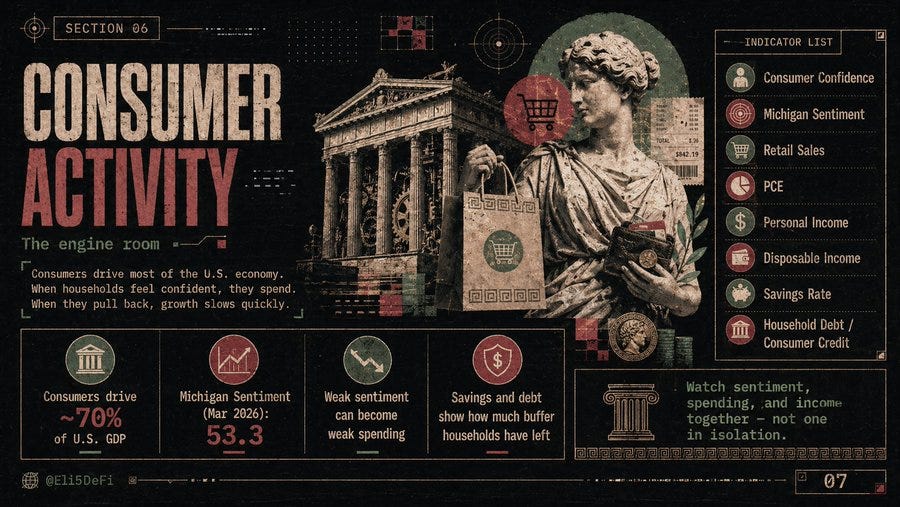
The Michigan Consumer Sentiment Index dropped to 53.3 in March 2026 — near the bottom 1st percentile of its entire history since 1978. That’s not a statistic to file away. That’s a signal that the people running the economy are scared.
Indicators:
Consumer Confidence Index (Conference Board) — more labor-market-sensitive; surveys ~3,000 households on current conditions and 6-month expectations
Michigan Consumer Sentiment Index — more price-sensitive; responds faster to cost-of-living shocks like energy prices
Retail Sales — monthly hard-spending data covering ~1/3 of consumer spending; the “control group” (ex-autos, gas, food services) feeds directly into GDP
Personal Consumption Expenditures (PCE) — broader than retail sales; covers all consumer spending including services
Personal Income — wages, rental income, transfer payments; the fuel for spending
Disposable Personal Income — income after taxes; what households actually have to spend or save
Personal Savings Rate — income not spent; low rates mean thin buffers if conditions deteriorate
Household Debt — total obligations (mortgages, auto, credit card, student loans); delinquency rates signal stress points
Consumer Credit — revolving (credit cards) and non-revolving (auto, student loans); rapid growth can signal either confidence or distress depending on context
Housing: The Economy’s Early Warning System
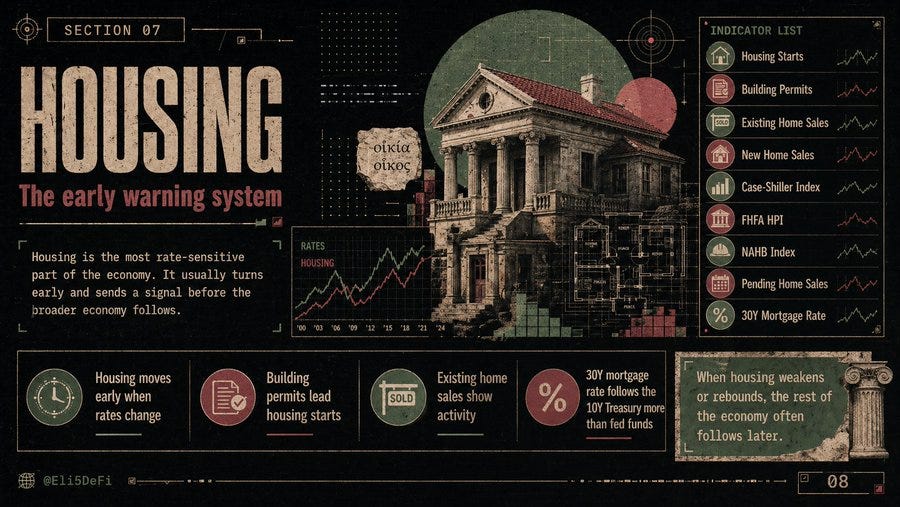
Housing is the most interest-rate-sensitive sector in the economy. It moves first when rates rise and first when they fall. A single home purchase triggers spending across lumber, appliances, furniture, landscaping, and construction labor. Housing starts are one of the 10 components of the Conference Board’s LEI.
Indicators:
Housing Starts — new construction projects broken ground; the activity measure
Building Permits — approvals not yet started; the forward-looking measure; a LEI component
Existing Home Sales — ~90% of all home sales; reflects actual market activity and is sensitive to mortgage rates
New Home Sales — builder sales; more sensitive to rate changes because builders can offer mortgage buydowns
Case-Shiller Home Price Index — tracks same-property repeat sales across 20 cities; the cleanest price measure
FHFA House Price Index — similar methodology, focuses on conforming loan market
NAHB Housing Market Index — builder sentiment survey; above 50 = favorable conditions
Pending Home Sales — signed contracts not yet closed; leads existing home sales by 1-2 months
30-Year Fixed Mortgage Rate — the direct transmission mechanism from Fed policy to housing demand; driven by the 10-year Treasury yield, not the fed funds rate directly
Trade: The Global Dimension
Indicators:
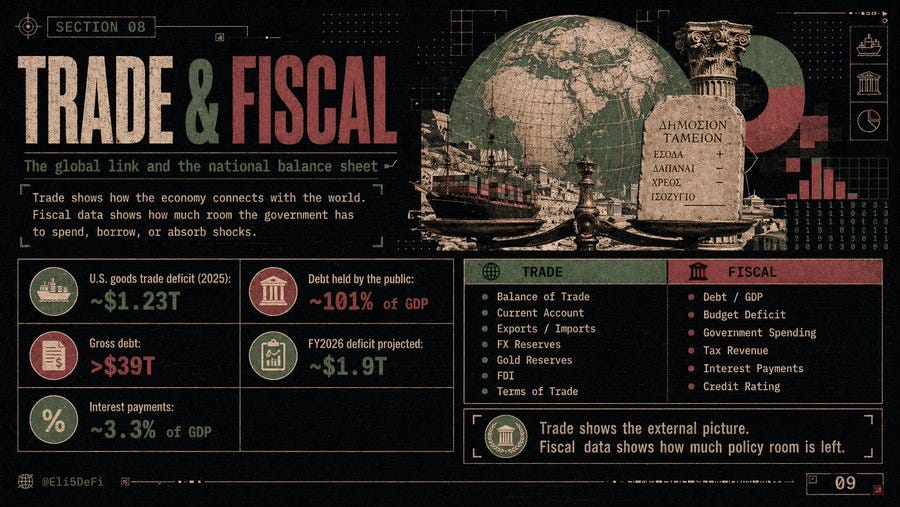
Balance of Trade — exports minus imports of goods and services; the U.S. runs a persistent deficit (~$1.23T goods deficit in 2025)
Current Account — trade balance plus investment income and transfers; the broadest cross-border flow measure
Exports / Imports — tracked separately; import growth often signals strong domestic demand, not economic weakness
Foreign Exchange Reserves — a central bank’s stockpile of foreign currencies for intervention and stability
Gold Reserves — the U.S. holds 8,133 tonnes; ultimate hard-asset backstop
Foreign Direct Investment (FDI) — long-term capital inflows from foreign entities building or acquiring businesses; signals confidence in the economy
Terms of Trade — ratio of export prices to import prices; when this improves, the same exports buy more imports
Government and Fiscal: The National Balance Sheet
Indicators:
Government Debt (% of GDP) — U.S. debt held by the public: ~101% of GDP; gross debt exceeds $39T
Budget Deficit / Surplus — annual shortfall or excess; FY2026 deficit projected at ~$1.9T (5.8% of GDP)
Government Spending — direct GDP component; also drives automatic stabilizers during downturns
Tax Revenue — the income side of the government ledger; drops sharply in recessions, reducing fiscal space
Interest Payments on Debt — now ~3.3% of GDP and rising; crowds out other spending at scale
Sovereign Credit Rating — S&P, Moody’s, Fitch assessments; the U.S. lost its last AAA rating (Moody’s) in May 2025
Financial Markets: The Economy’s Nervous System
Indicators:
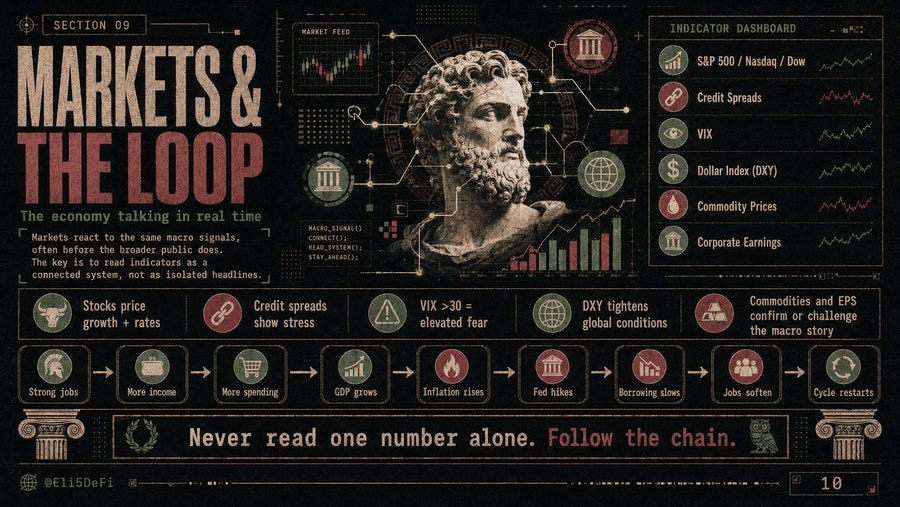
Equity Indices (S&P 500, Nasdaq, Dow) — forward-looking; price in expected earnings and discount rates simultaneously; a Conference Board LEI component
Credit Spreads — gap between corporate and Treasury yields; widens on recession fears, tightens on confidence; investment-grade and high-yield tracked separately
VIX (Volatility Index) — implied volatility on S&P 500 options; “fear gauge”; above 30 signals elevated market stress
Dollar Index (DXY) — U.S. dollar against a basket of major currencies; strong dollar = lower import inflation, tighter financial conditions globally
Commodity Prices — oil (inflation + growth proxy), copper (industrial activity, often called “Dr. Copper”), gold (uncertainty hedge), agricultural commodities (food inflation)
Corporate Earnings (EPS Growth) — the fundamental driver of equity valuations; confirms or contradicts the macro growth narrative
How It All Connects
These indicators don’t exist in isolation. They form a loop.
Strong jobs → more income → more spending → GDP grows → businesses hire more → inflation rises → Fed raises rates → borrowing gets expensive → spending slows → jobs soften → cycle restarts.
Once you see this chain, the news makes more sense. A hotter-than-expected jobs report causes bond yields to rise because traders are pricing in fewer rate cuts.
A weak inflation print makes stocks rally because rate cuts feel closer. A yield curve that un-inverts can signal the real recession risk is arriving, not receding. The indicators are the economy talking.
Learning to read them means you stop being surprised by the story.

Check My Other Channels:
Substack →

Telegram → https://t.me/eli5definews
Disclaimer: This information is for educational purposes only and does not constitute professional financial or tax advice. Some content may be developed in collaboration with third parties, and we may hold positions in the assets mentioned. We strongly recommend conducting independent research and consulting with a qualified professional before making any financial or tax-related decisions.