Memecoin is The Acquisition Layer of Crypto


You can say what you want but we must admit that memecoins are the fastest, cheapest, and most effective gateway for new chains to solve the cold-start liquidity problem:
Attract speculative capital
Create real liquidity pools
Onboard wallets at scale
And generate the activity and mindshare that serious builders then follow.
This is something DeFi and any other project utilities couldn’t do, not even RWA.
Robinhood Chain posted $800 million in daily DEX volume. $CASHCAT, one of its leading memecoins, ran from launch to a $200 million peak market cap before settling around $152-174 million. Active addresses hit 108,000 with 6.15 million weekly transactions.

This is not noise. It is the same mechanism that took Base from a few million in TVL to $78 million in roughly 48 hours during the BALD launch, and that pushed Solana DEX volumes to $3.8 billion on single days while monthly volumes reached $124 billion in late 2024.
Memecoins are the fastest, cheapest, and most effective gateway new chains have ever had for solving the cold-start problem. They attract speculative capital at scale, create real liquidity pools overnight, onboard wallets by the hundreds of thousands, and generate the activity and mindshare that serious builders actually follow.
DeFi primitives, utility tokens, and even RWAs have never done this at comparable speed or cost. They require education, trust, audits, legal wrappers, or yield narratives. Memecoins require none of that, only asymmetric upside and social velocity.
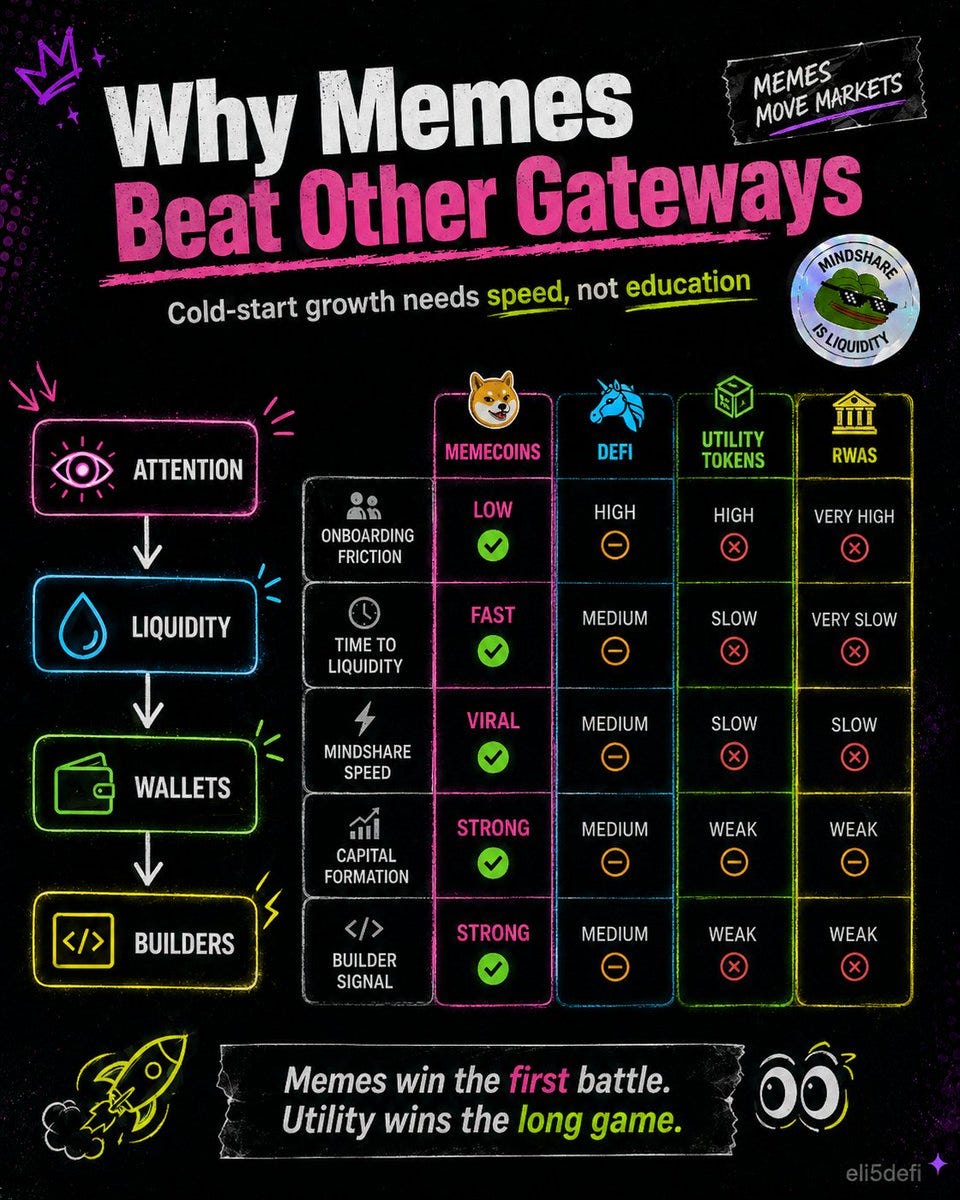
The chains that convert the initial heat into utility layers keep a slice of that liquidity sticky. The ones that treat memes as the destination watch the capital rotate to the next chain with better conversion.
The Memecoin Bootstrap Cycle
New chains (or new L2s/appchains) compete in an attention-scarce market. Most serious DeFi or infrastructure plays require education, trust, and time. Memecoins require none of that.
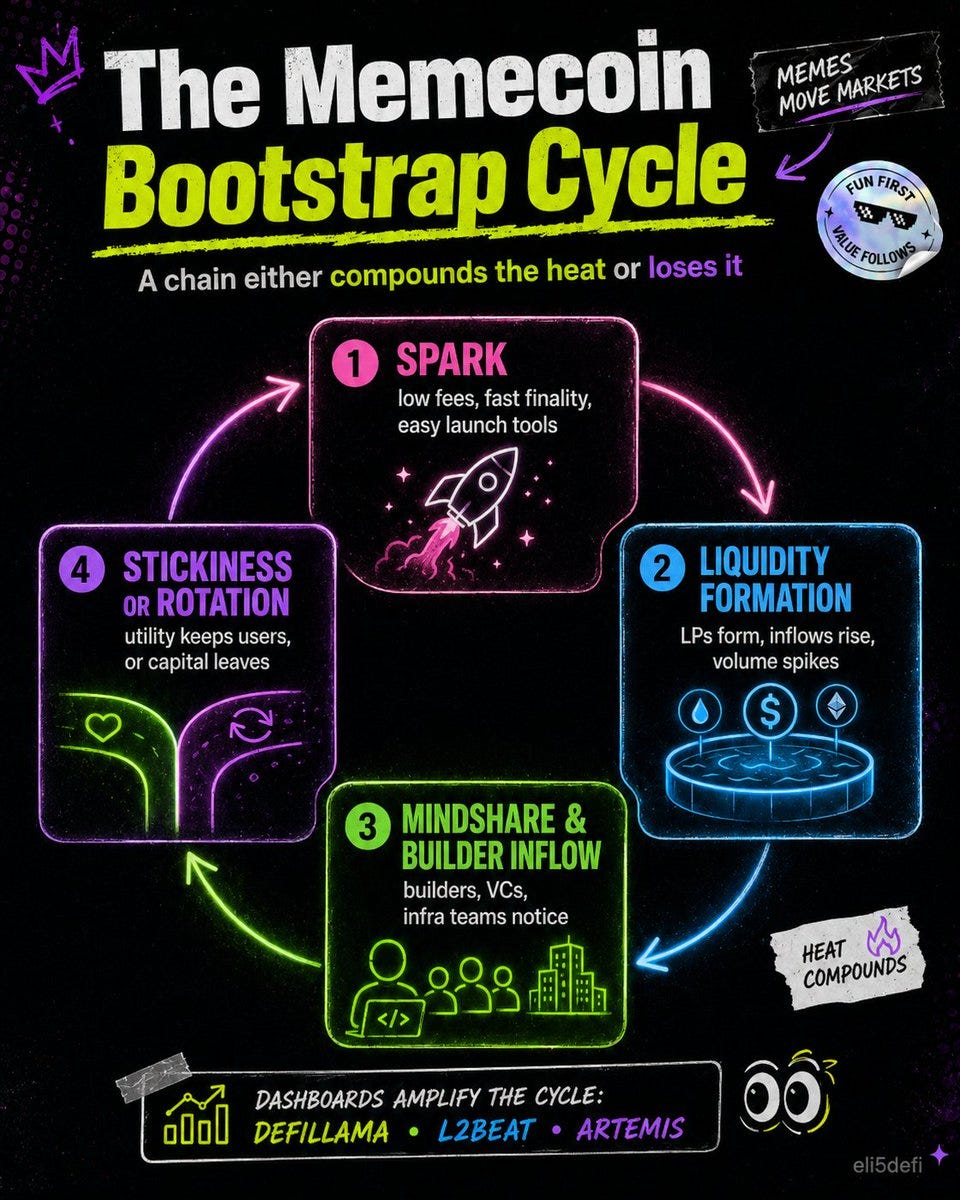
Phase 1 – Spark
Low or zero fees + fast finality + simple launch tooling (Pump.fun-style bonding curves that auto-migrate to the native DEX). A token can go from idea to live trading in minutes. Speculators arrive because the math is asymmetric: small capital, lottery-ticket upside, social proof on X and Telegram.
Phase 2 – Liquidity Formation
Every meaningful launch creates a real liquidity pool on the chain’s DEX. Bridges see net inflows. Active addresses and transaction counts spike. Fee revenue to validators or the chain treasury rises. The chain climbs public dashboards (DefiLlama, L2BEAT, Artemis). That ranking itself becomes marketing.
Phase 3 – Mindshare & Builder Inflow
Volume is the loudest signal in crypto. Developers, VCs, and infrastructure teams notice. They deploy or port. A DEX matures, lending markets appear, oracles improve, agent frameworks launch. The original meme traders become the user base for these new primitives.
Phase 4 – Stickiness or Rotation
Liquidity either compounds or leaves. It sticks when there are reasons to stay: real yield, composable apps, lower future friction, community ownership, or airdrop/utility incentives tied to ongoing activity rather than pure holding. It rotates when the chain offers nothing beyond the next 100x gamble.
The data shows this pattern repeats. The variable is whether the chain has the distribution, infrastructure, and execution to convert Phase 2 into Phase 4.
Solana: The Full Flywheel at Scale
Solana had the technical base (high throughput, sub-second finality, low fees) but needed narrative and users after the FTX collapse. The 2023–2025 memecoin cycle delivered both.
Pump.fun turned token launches into a consumer product. Thousands of fair launches happened. Successful ones graduated to Raydium (and later Meteora, Orca). Raydium volumes routinely exceeded $1–3 billion daily during peaks; Pump.fun itself hit a $2 billion daily DEX volume ATH in early 2026 and ranked among Solana’s top DEXes by volume.
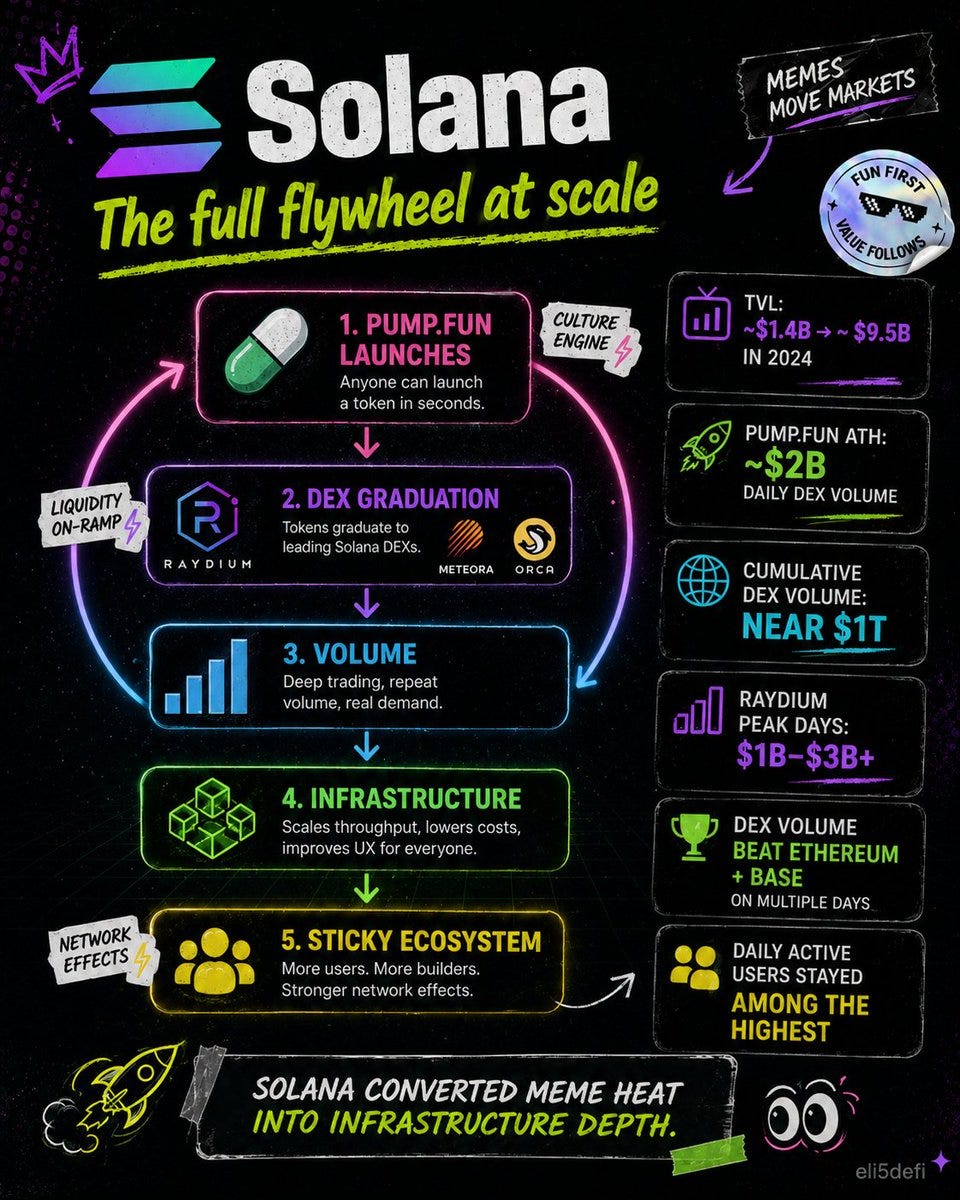
Solana’s TVL rose roughly 5x in 2024 alone, from ~$1.4 billion to ~$9.5 billion. Cumulative DEX volume approached $1 trillion. Solana DEX volumes beat Ethereum + Base combined on multiple days.
The liquidity did not all evaporate when individual memes cooled. It paid for validator security, better RPCs, priority fee markets, and token extensions that improved the trading experience for everything that followed. Builders arrived for the users and the volume: DePIN projects, AI agent platforms, compressed NFT infrastructure, and improved perps and lending rails. Daily active users remained among the highest in crypto into 2025–2026.
Solana turned memecoin speculation into durable on-chain habits and infrastructure depth. The liquidity became stickier because there were now real things to do with it beyond gambling.
Base: Coinbase Distribution + Early Meme Spark
Base launched in August 2023.
$BALD launched shortly after and delivered the classic “hundredfold in a day” event. TVL jumped from roughly $2 million to $78 million in ~48 hours as hot money bridged in and liquidity pools formed.
The effect is palpable.
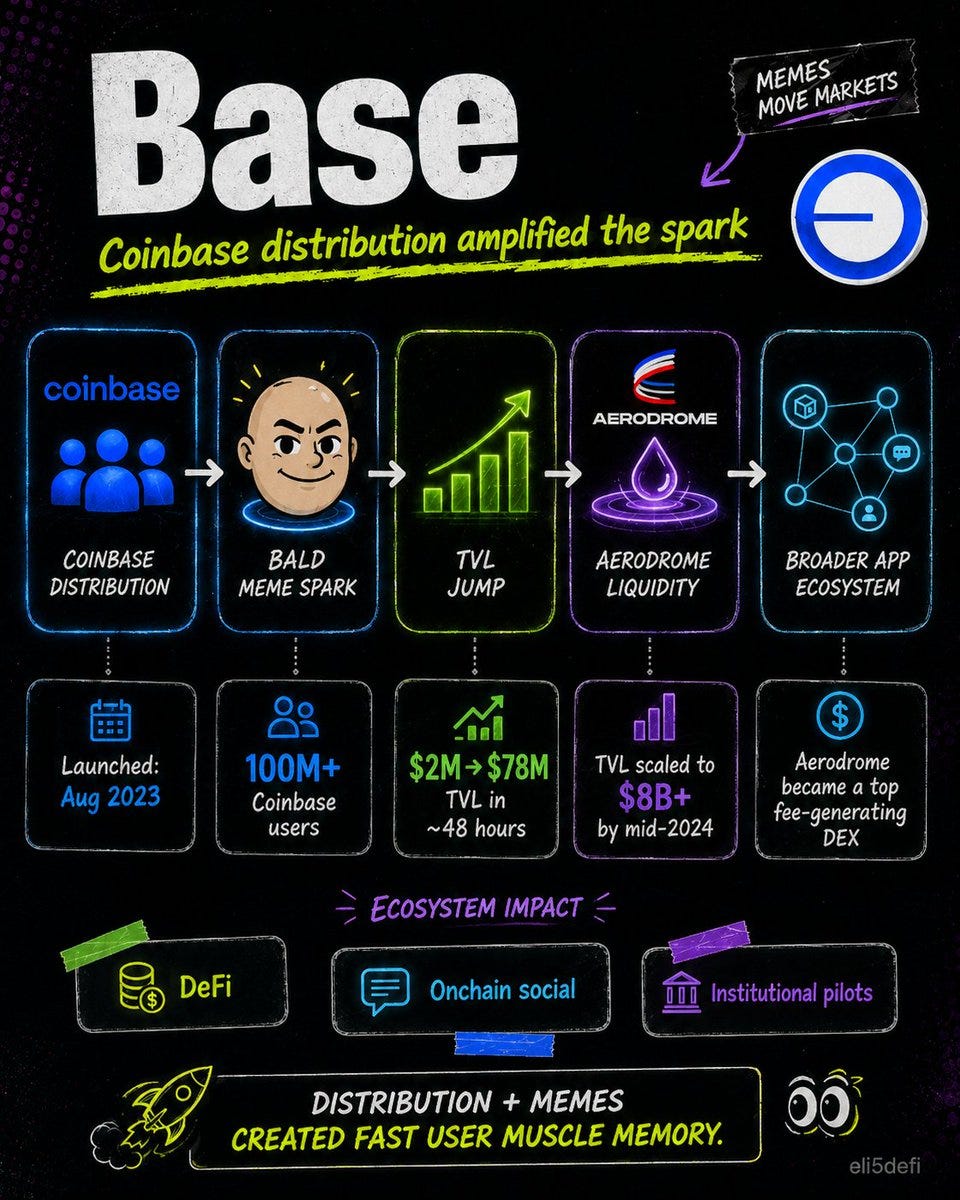
Coinbase’s distribution (100+ million users, seamless fiat on/off-ramps inside the app) gave Base an on-ramp most new chains lack. Memecoin trading drove transaction counts higher than most competing L2s. Aerodrome quickly became one of the highest-fee-generating DEXes in crypto.
Base did not stop at the meme phase.
TVL scaled to $8 billion+ by mid-2024 and held meaningful share thereafter. Ecosystem growth continued into DeFi primitives, onchain social experiments, and institutional pilots. The initial speculation created liquidity depth and user muscle memory that later projects could build on.
Robinhood Chain: TradFi Brand Meets Meme On-Ramp
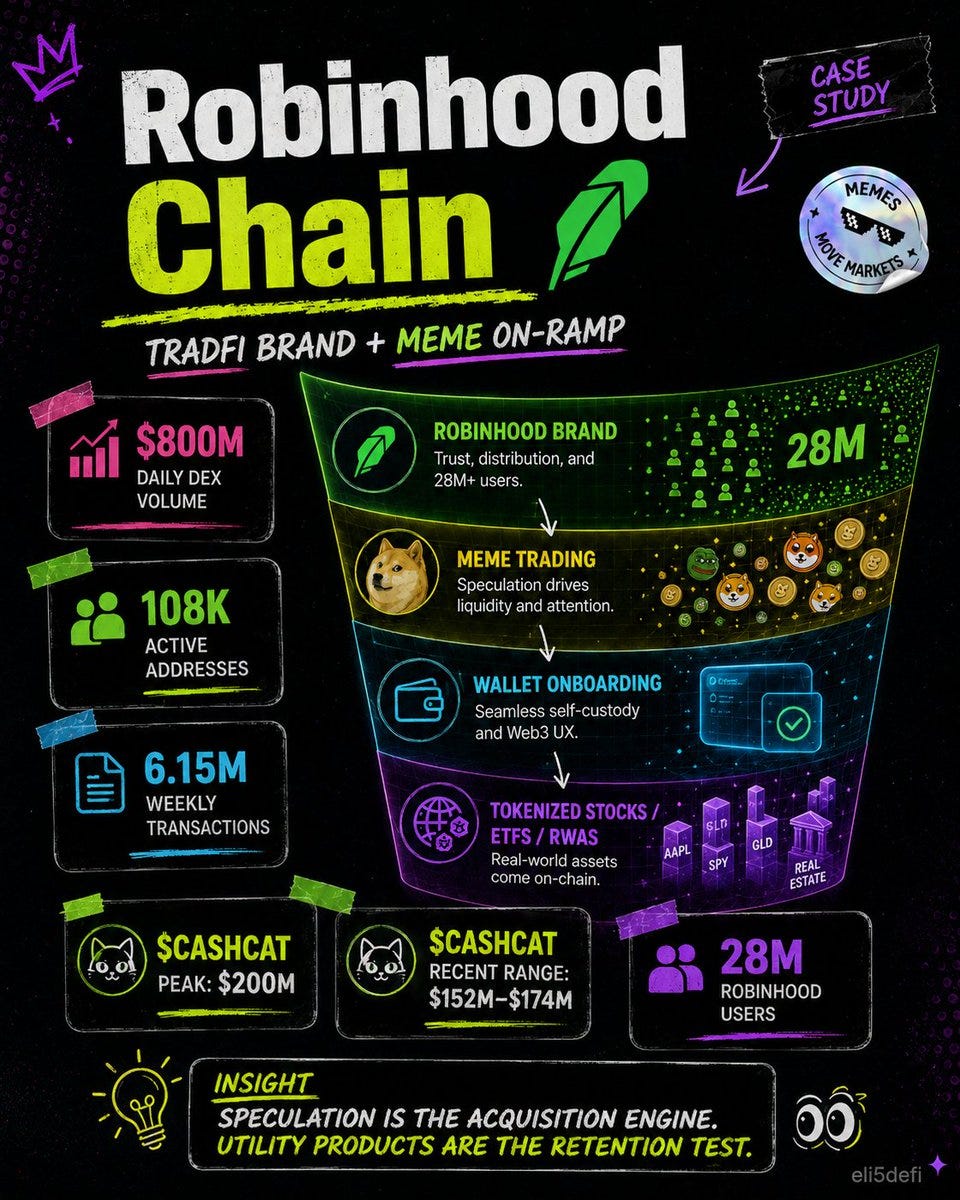
Robinhood Chain is the freshest live example. It combines a recognizable consumer brand (28 million users) with the same memecoin bootstrap playbook.
$800 million daily DEX volume, led by tokens like $CASHCAT, produced 108,000 active addresses and millions of weekly transactions in a short window.
The chain offers low fees and fast blocks tailored for high-frequency token trading and, longer-term, tokenized stocks, ETFs, and RWAs.
The thesis is explicit: use the meme meta and brand familiarity to onboard people who have never used a crypto wallet. Once they are inside the app, comfortable bridging or buying, and habituated to on-chain trading, layer on the regulated, yield-bearing, or utility products Robinhood already understands from TradFi. Speculation becomes the customer acquisition engine; stickiness comes from the next layer of products.
Early data shows the volume and address growth are real. Whether the conversion to durable utility layers follows is the open question that will define its trajectory.
Ethereum & Shiba Inu: The Historical Template
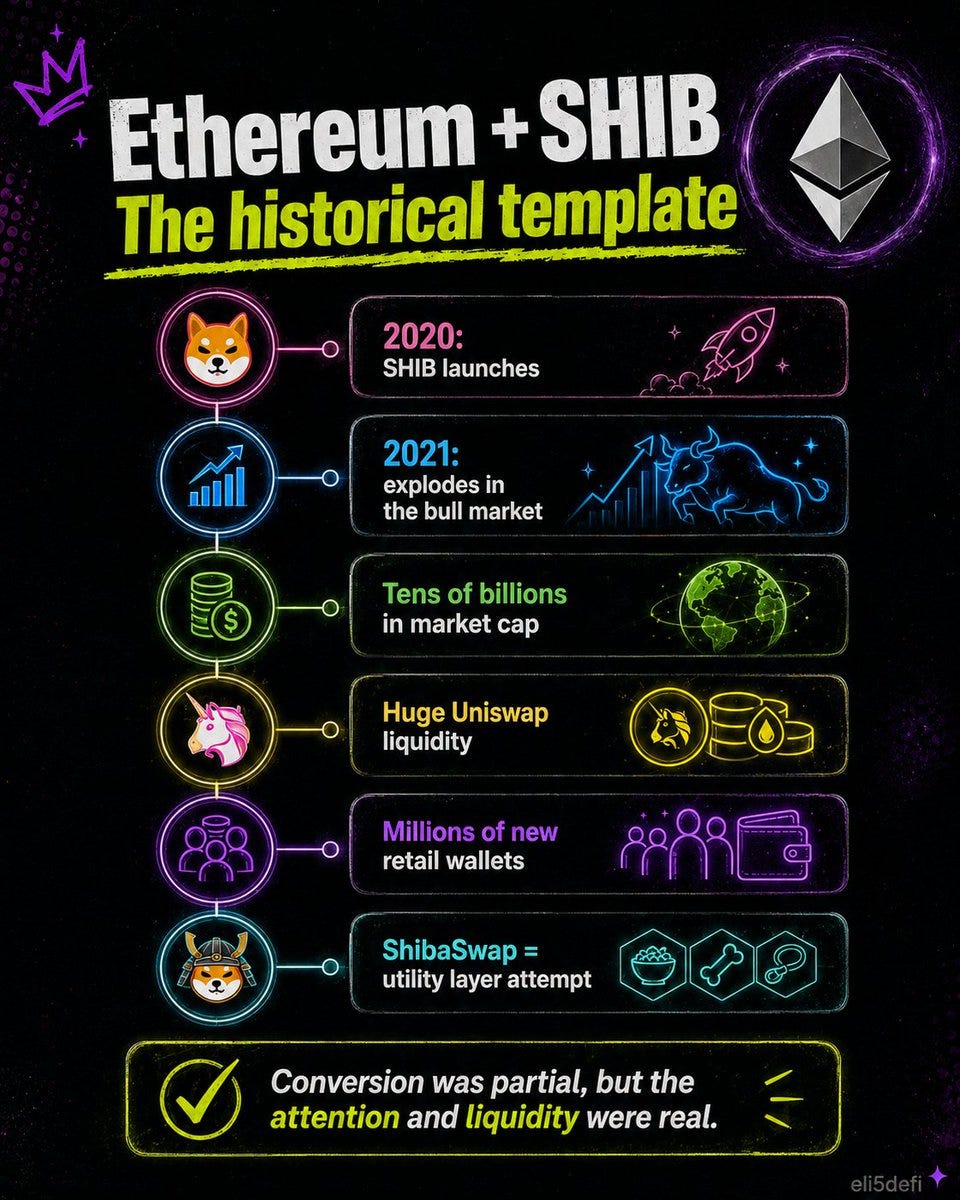
Even a mature chain used the pattern. SHIB launched in 2020 and exploded in the 2021 bull market, reaching tens of billions in market cap.
It created enormous Uniswap liquidity, brought millions of new retail wallets into Ethereum DeFi, and proved memecoins could generate cultural scale and on-chain volume. ShibaSwap launched as the attempted utility layer. The attention and liquidity were genuine; the conversion to sticky, long-term activity on Ethereum was partial but still net positive for the ecosystem’s mindshare.
Mature chains do not need memes to survive. New chains often do.
Why Memecoins Work Better Than Most Alternatives as a Gateway
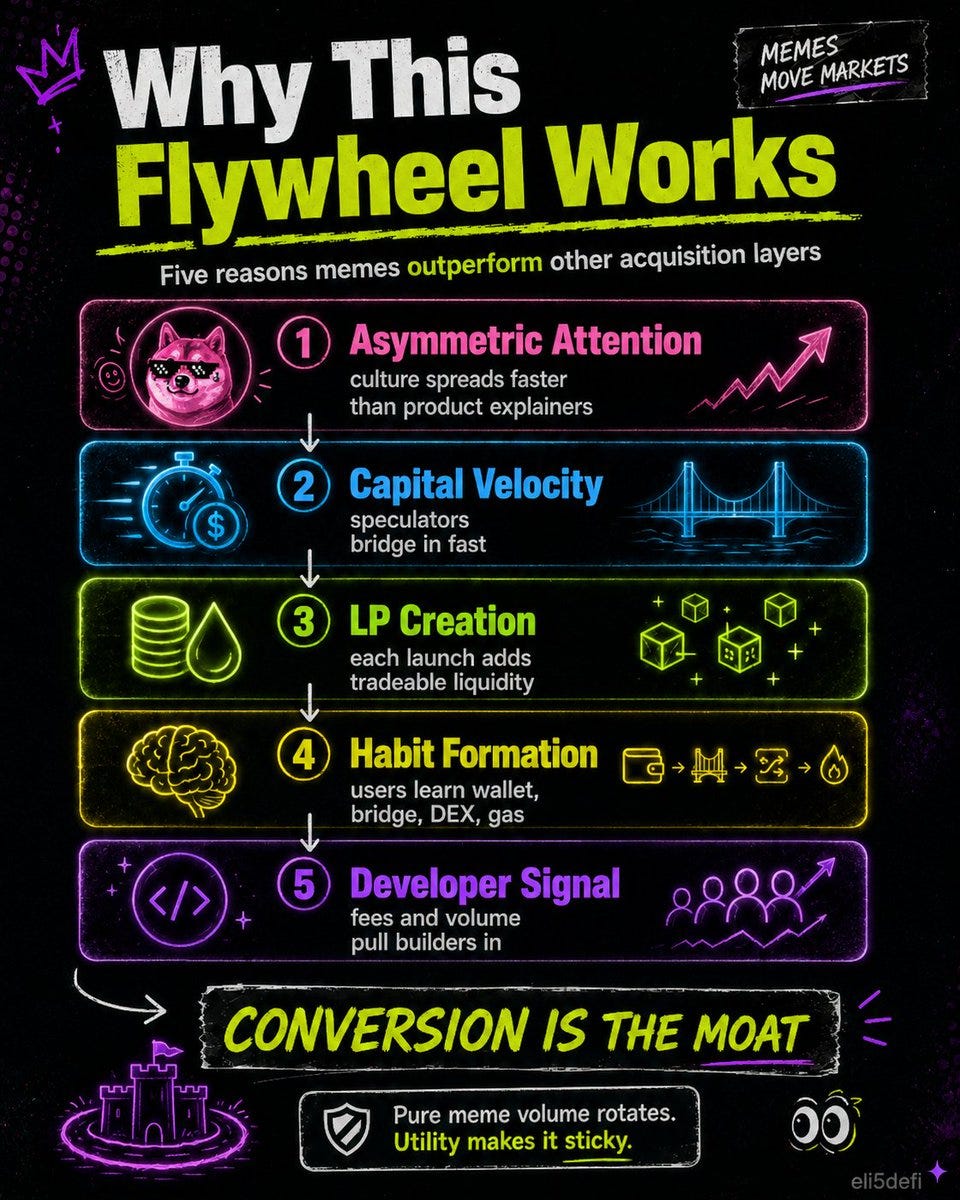
Asymmetric attention: A single strong meme can reach more eyeballs on X/TikTok in days than most serious protocol launches achieve in months.
Capital velocity: Speculators do not need deep tokenomics research or multi-week due diligence. They bridge or on-ramp and trade.
Liquidity creation at the margin: Every successful launch adds a real, tradeable LP. That depth benefits every subsequent token and app on the chain.
Habit formation: Users learn the wallet, bridge, DEX, and gas model. The next time they come for yield, agents, or RWAs, the switching cost is low.
Developer signal: High visible volume + fee revenue tells builders the chain is live and users are present. Builders follow users and fees.
The conversion step is what separates durable ecosystems from narrative casinos. Pure meme volume is cyclical and rotates. Utility layers (real yield, composable apps, distribution advantages, credible incentives) give capital reasons to remain deployed rather than chase the next chain’s launch meta.
Memecoin-driven growth is not free. Many chains stay in “Phase 2” and fade when the meta moves. Mercenary capital leaves faster than it arrives. High launch velocity also means high scam and rug frequency, which poisons perception. Over-reliance on meme activity can deter institutional or long-term capital that wants predictable, regulated rails. Regulatory scrutiny on memecoins remains a tail risk that can narrow the on-ramp for everyone.
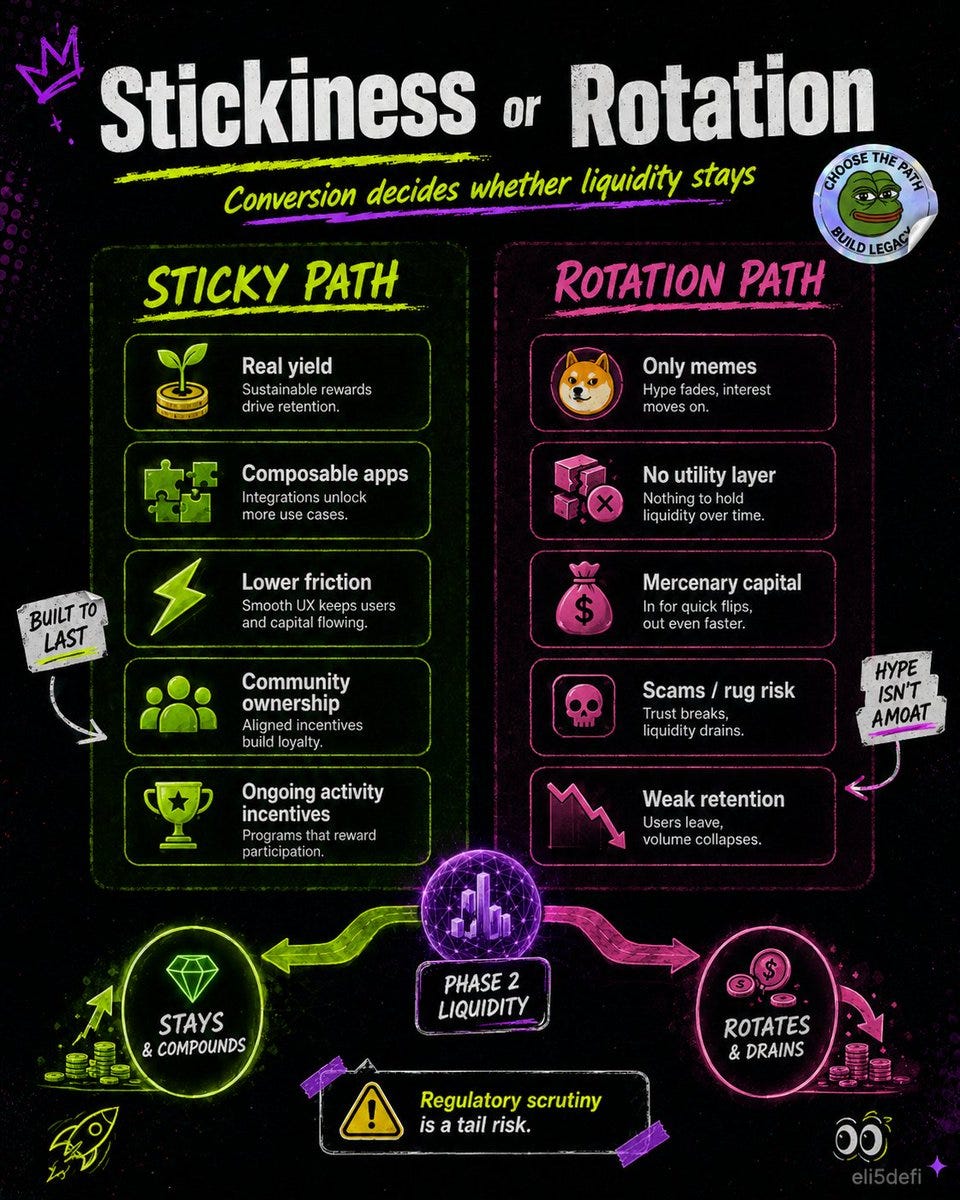
Chains that treat memes as the product rather than the acquisition layer usually end up with thin, volatile liquidity and low retention once hype rotates.
Verdict: Conversion Is the Moat
New chains that successfully facilitate cheap, fast token trading and memecoin liquidity formation win the first battle for attention and capital. The ones that win the war treat that activity as Phase 1 of a deliberate sequence:
Memes bring the liquidity and users.
Infrastructure and distribution convert attention into habit.
Utility and yield layers make a portion of that liquidity sticky.
Solana executed at scale. Base used Coinbase distribution to amplify the effect. Robinhood Chain is attempting it with consumer-brand leverage and an existing 28-million-user base.
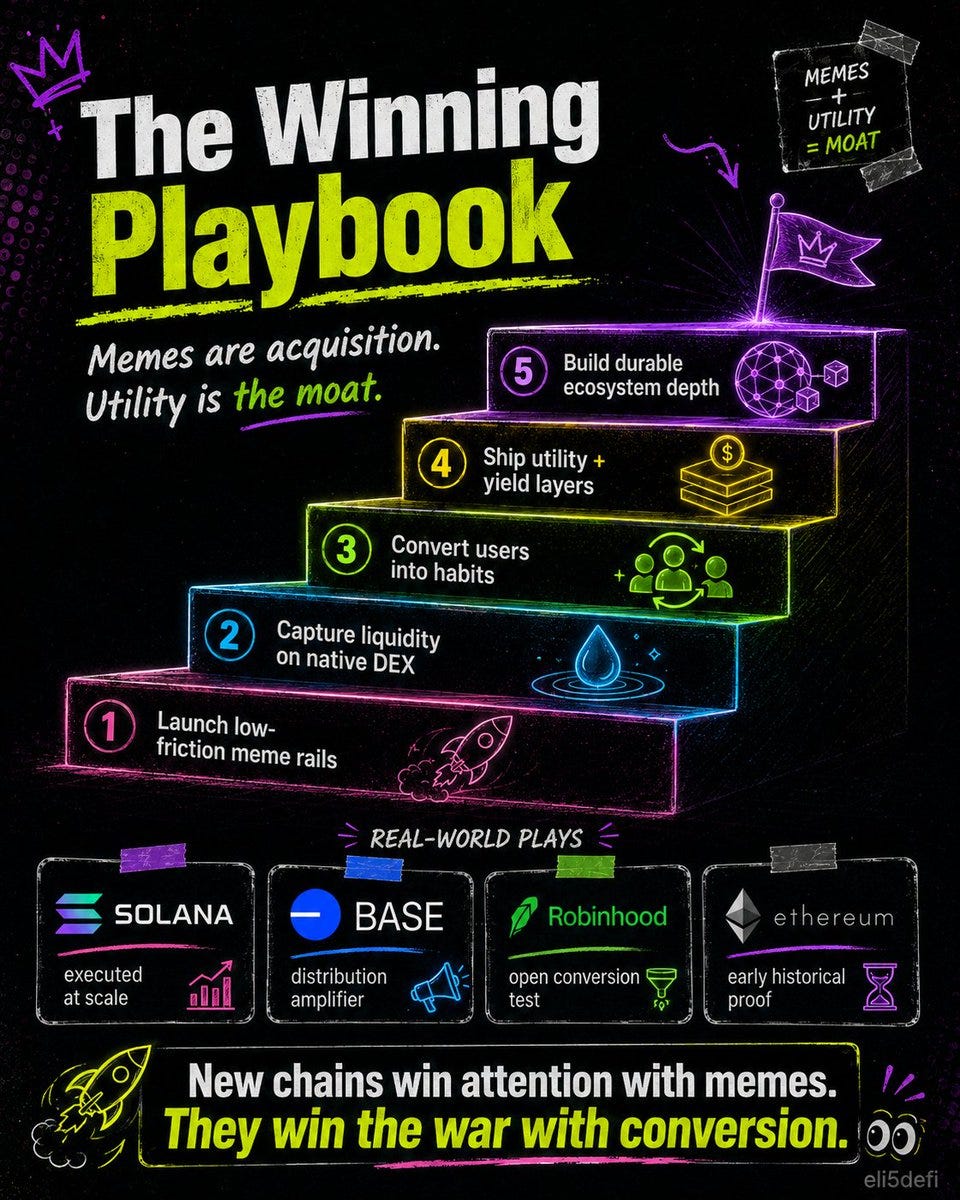
However, the pattern is repeatable. The execution is not.
In a market with dozens of competing L2s, appchains, and consumer-facing chains, the ability to turn speculative inflows into durable on-chain activity is the difference between a liquidity event and a durable ecosystem.
To date, memecoins are the most effective liquidity and on-ramp layer in the history of crypto. Nothing else has come close.
NFA. DYOR.
Disclaimer: This information is for educational purposes only and does not constitute professional financial or tax advice. Some content may be developed in collaboration with third parties, and we may hold positions in the assets mentioned. We strongly recommend conducting independent research and consulting with a qualified professional before making any financial or tax-related decisions.
Substack →

Telegram →