
The Polkadot Halving Complete Guide - All You Need to Know


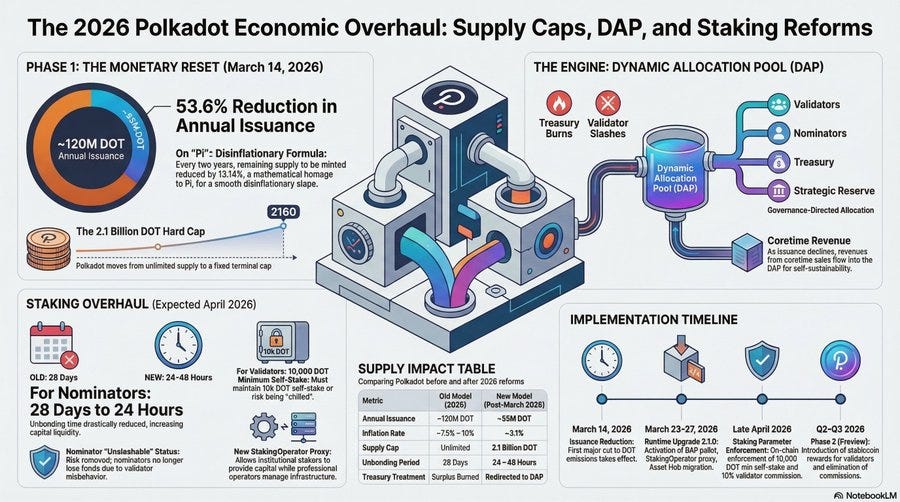
@Polkadot just executed the most significant monetary policy overhaul in its history, cutting annual $DOT emissions by 53.6% and capping total supply at 2.1 billion.
The inflation model that frustrated the ecosystem for years is effectively over, but we know that’s not the full story.
TL;DR
Annual issuance drops from 120 million DOT to 55 million DOT as of March 14, 2026. Inflation falls from ~10% to ~3.1%.
The Dynamic Allocation Pool (DAP) replaces treasury burns, redirecting slashes, coretime fees, and newly minted DOT into a governance-controlled buffer instead of destroying them.
Staking mechanics are getting overhauled in April 2026. Nominators lose their slashing risk, unbonding compresses from 28 days to 24-48 hours, and validators need 10,000 DOT in slashable self-stake.
Validator consolidation risk is real. The 10,000 DOT minimum will force smaller validators out or into the new StakingOperator proxy structure, with unknown effects on decentralization near-term.
Where This Actually Began
Two years ago, a community member named Josiah Kotzur posted Wish for Change referendum 1049 on Polkassembly. The proposal was blunt: cut DOT inflation by 50%, call it “The Polkadot Halving,” market it alongside Bitcoin’s next halving, and repeat the exercise every four years.
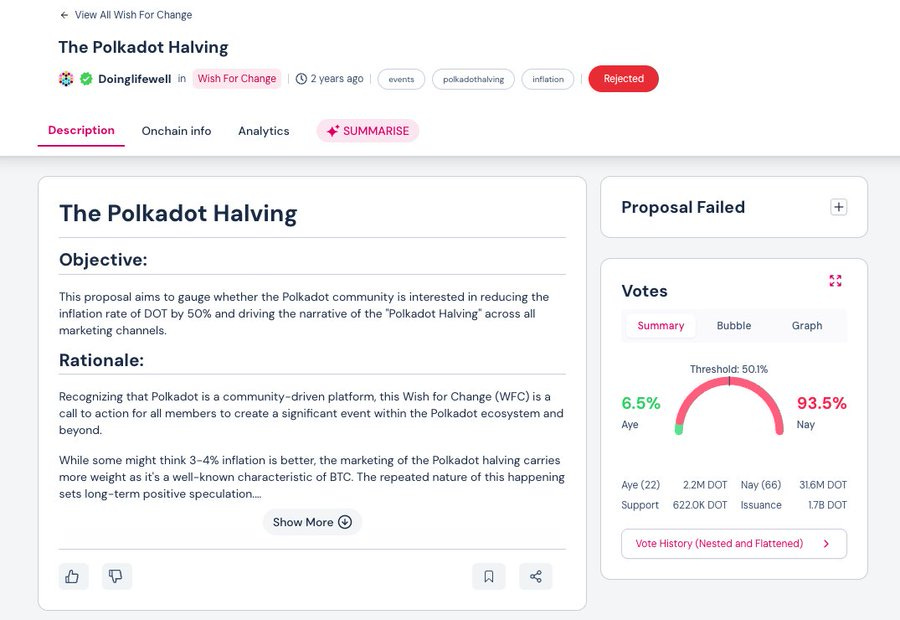
It got rejected.
The rejection of referendum 1049 was not a vote against the idea. It was a vote against doing it badly.
What emerged instead, through 18+ months of forum debate, competing proposals, and fellowship input, was referendum 1710. Polkadot’s on-chain governance approved it with 81% approval, imposing a hard cap of 2.1 billion DOT and replacing the prior unlimited-issuance model entirely.
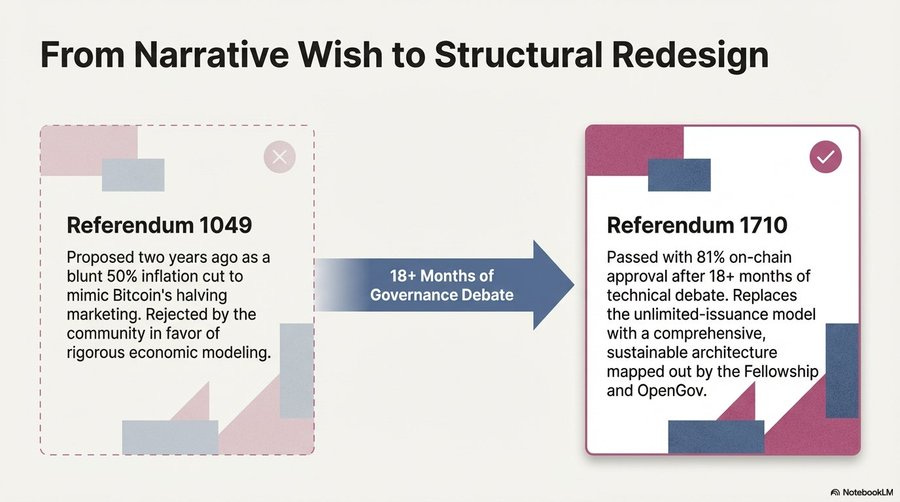
The difference between what Josiah proposed and what passed is the difference between a narrative move and a structural redesign.
How the Issuance Formula Actually Works
This is not a true halving. It is a mathematically smoother, more deliberate mechanism.
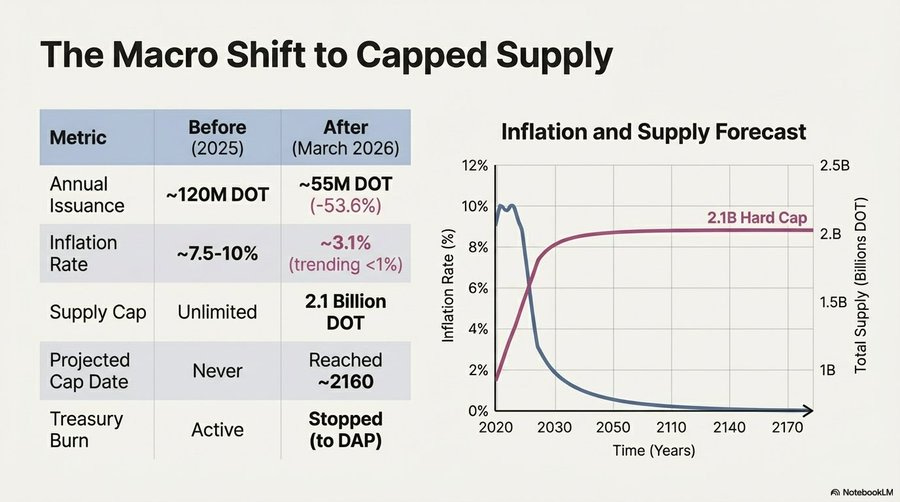
Issuance is reduced every two years by exactly 13.14% of the remaining supply to be minted, a numerical homage to the value of Pi, immediately dropping the annual inflation rate from roughly 10% to approximately 3.11%, then below 1% by the early 2030s.
Bitcoin’s halving creates a cliff. Polkadot’s formula creates a slope. The 13.14% cut applies to remaining issuance, not total supply, so every cut is smaller in absolute DOT terms but compound in disinflationary effect.
The first issuance drop lands on Pi Day (March 14), a date that also falls close to Bitcoin’s estimated next halving date, helping the two ecosystems cross-promote each other’s mint-reduction events.
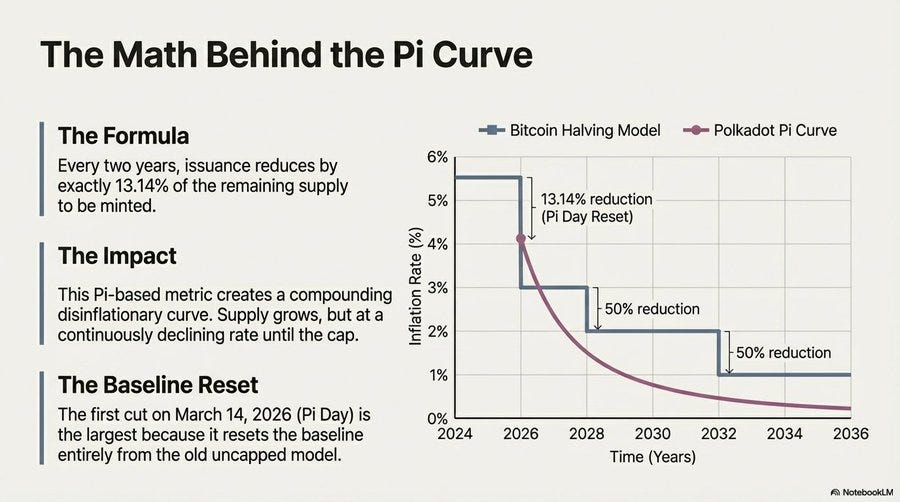
The next Bitcoin halving is expected around March 27, 2028, just weeks after Polkadot's second issuance cut.
The DAP: The Mechanism Everyone Is Underreacting To
The Dynamic Allocation Pool (DAP) is the thing that makes declining issuance actually viable.
Under the old model, surplus treasury DOT got burned. Destroyed. Gone. The DAP replaces that with a governed buffer that collects all protocol revenue and allocates it where the network needs it.
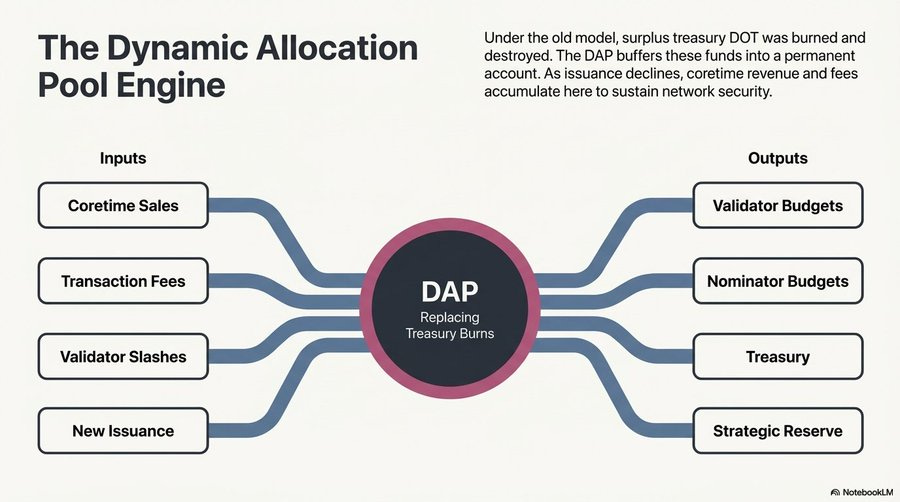
Rather than burning surplus DOT, the DAP collects transaction fees, coretime sales, and slashes, enabling governance to dynamically allocate funds across distinct budgets for validators, nominators, the treasury, and a strategic reserve.
What flows into the DAP:
Newly minted DOT (under reduced issuance schedule)
All validator slashes (previously went elsewhere)
Coretime sales revenue (Polkadot’s block space market)
Transaction fees
What the DAP allocates out to:
Validator rewards
Nominator rewards
Treasury (grants, development, ecosystem)
Strategic reserve (new bucket, previously non-existent)
The strategic reserve is the underappreciated piece. As coretime revenue grows, the protocol has a path toward self-sustaining security costs without relying on freshly minted supply.
That is the long-term bet: fee revenue fills the gap issuance leaves behind. Whether that actually works at scale is the open question.
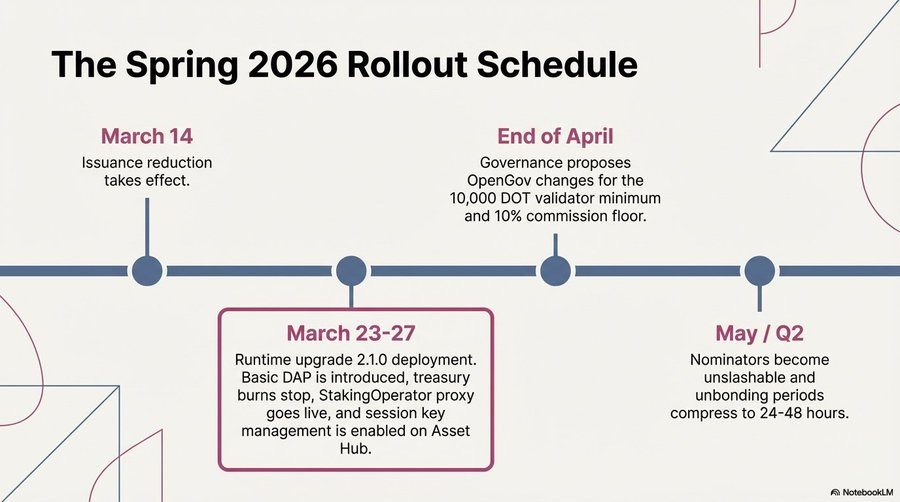
Phase 1 of the DAP goes live with the 2.1.0 runtime upgrade expected between March 23-27, and introduces a basic DAP pallet plus a permanent on-chain account that holds DOT, with treasury burns stopped and validator slashes redirected into it.
Staking: What Changes and When
For Validators
Timeline: End of April 2026
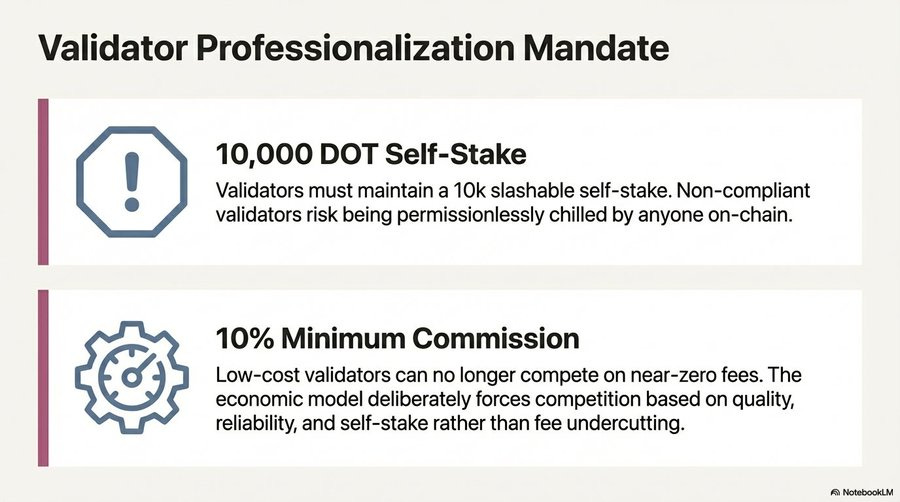
10,000 DOT minimum self-stake required. This stake must be slashable.
10% minimum commission enforced. Low-fee validators lose their primary competitive angle overnight.
Permissionless chilling kicks in. Validators that don’t have at least 10,000 DOT in self-stake when the minimum is introduced will be at risk of being permissionlessly chilled by anyone. Not Parity. Not governance. Anyone.
Session keys migrate to Asset Hub. Set using stakingRcClient. A 10 DOT deposit is required. Relay Chain method still works during transition but gets deprecated eventually.
New: StakingOperator Proxy
Institutional staking providers who run validators on behalf of clients hit a problem: they may not want to post 10,000 DOT themselves.
The StakingOperator proxy allows the Staker to control the account that appears on-chain as the validator, which holds the self-stake. That account can have a StakingOperator proxy with a narrow set of permissions, controlled by the Operator running the node, enabling Operators to run validators on behalf of Stakers in a fully non-custodial way.
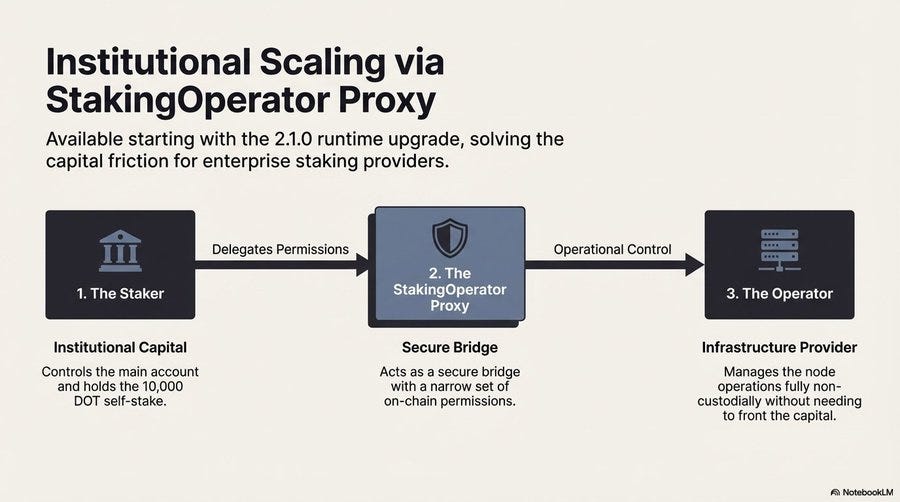
This is already live on Westend for testing.
For Nominators
Timeline: Q2 2026 (after validator minimums take effect)
This is genuinely the best upgrade retail stakers have received since launch.
✅ Nominators become unslashable. No more punished-for-your-validator’s-mistakes risk. Delegate freely.
✅ Unbonding compresses from 28 days to 24-48 hours. Capital that was frozen for a month becomes effectively liquid.
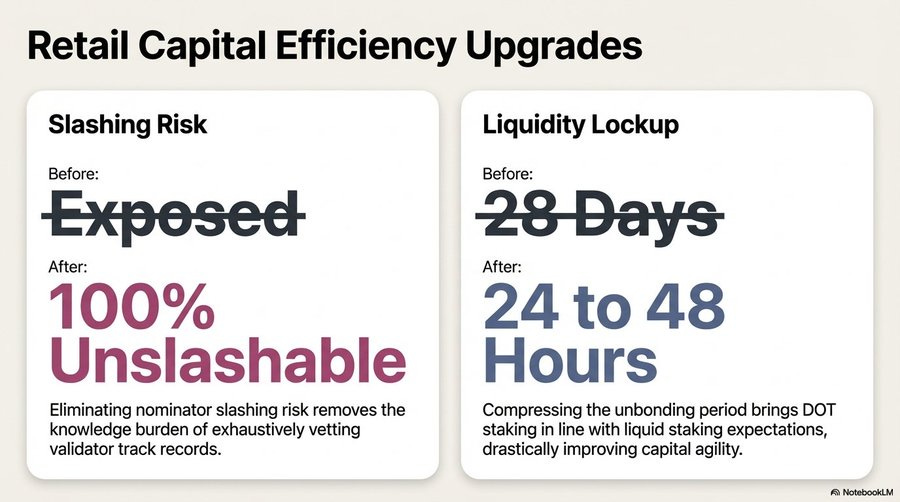
The 28-day unbonding period was one of the most cited reasons people preferred liquid staking alternatives. That friction is being removed.
Phase 2 Preview (Q2-Q3 2026, not yet final)
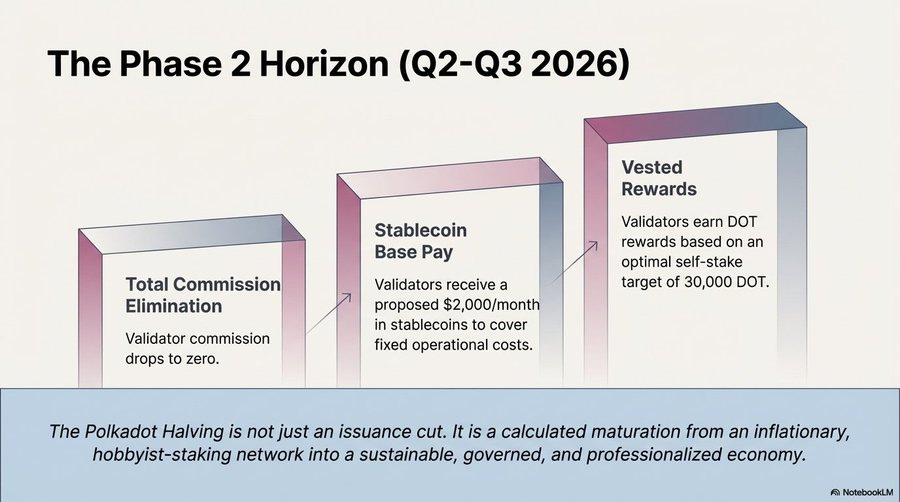
Phase 2 proposes validators earn three types of rewards:
DOT rewards linearly vested over a year dependent on self-stake amount
A stablecoin reward for operational costs ($2,000 per month per node)
Nominator rewards on top of the vested rewards.
The proposed optimal self-stake target is 30,000 DOT, capped at 100,000 DOT for reward generation. There is no more validator commission in Phase 2
Nothing about Phase 2 is live or finalized, community still has to ratify it. But the direction is clear: professional operator model, stablecoin for opex, DOT for capital at risk.
External Catalysts
Two catalysts will make or break Polkadot’s new economic model.
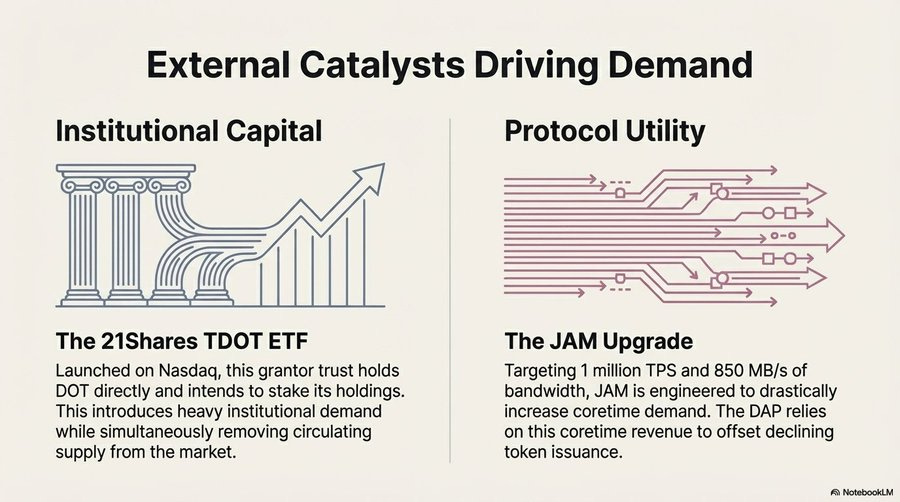
The first US DOT ETF, listed on Nasdaq. It holds DOT directly and can stake a portion of its holdings.
Why it matters:
Institutional capital enters through a regulated channel
Staked ETF holdings reduce circulating supply
Combines with the new hard supply cap to tighten the float
JAM Upgrade (2026)
JAM replaces the Relay Chain. It is the demand-side thesis that justifies the supply cuts.


What it brings:
1 million TPS theoretical throughput
850 MB/s bandwidth, 2 Petabytes of data availability
Coretime revenue flowing into the DAP as block space demand grows
The core bet: JAM drives enough coretime sales to keep the DAP funded as DOT issuance declines.
⚠️ Real Risks
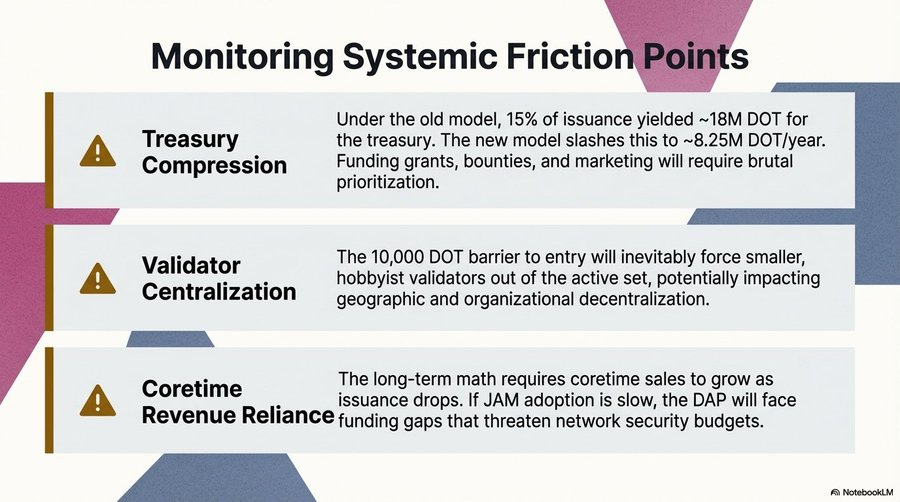
Validator consolidation. The 10,000 DOT minimum will eliminate or consolidate smaller validators. The StakingOperator proxy helps institutional setups but accelerates professionalization in ways that may reduce geographic and operator diversity. My suggestion is to watch the active validator count in Q2.
Coretime revenue gap. The DAP’s long-term viability assumes coretime sales grow in proportion to declining issuance. That market is still early. If adoption is slow, governance faces a funding shortfall with no clean solution.
Phase 2 is unratified. The stablecoin rewards, vested DOT schedule, and commission elimination are all governance proposals, not live code. The numbers will likely change before Phase 2 ships.
Europe supercluster latency. From the Polkadot Forum: validators outside Europe, especially US West Coast, Asia, Oceania, and South America, are already seeing reduced era points due to latency toward the dominant supercluster. In Phase 2 when rewards become proportional to era points with no commission buffer, this gap becomes a direct income issue.
Wrap-Up
Referendum 1049 asked for a cut and a story.
The community spent two years building something harder to summarize but more defensible: a bounded supply schedule, a governed revenue buffer, and staking mechanics that remove retail friction while professionalizing the validator layer.
Over 62% of DOT is already staked for network security, removing it from daily trading. Compress unbonding to 48 hours, remove slashing risk for nominators, add an institutional ETF structure, and set a hard supply cap. The setup on paper is cleaner than it has been at any point in Polkadot’s history.
The supply side is done. The demand side is the only question left.