
The "Vibe Coding" Apocalypse

Here is the uncomfortable truth the engineering world is trying to ignore: Software is no longer a craft; it is a content stream.
For decades, we treated code like a sacred artifact.
Codes are forged by experts (engineers), polished by guilds (code review), and carefully placed into a museum (production). But the explosion of AI-driven generation a.k.a. “vibe coding” has collapsed the cost of production to near zero.
We are witnessing the “TikTok-ification” of software development.
Just as digital cameras didn’t kill photography but turned it into an abundant, unmanageable stream that required algorithmic feeds to sort, AI is turning software into an abundant stream of executable logic.
The era of the “Authored Artifact” is dead. Welcome to the era of User-Generated Software (UGS).
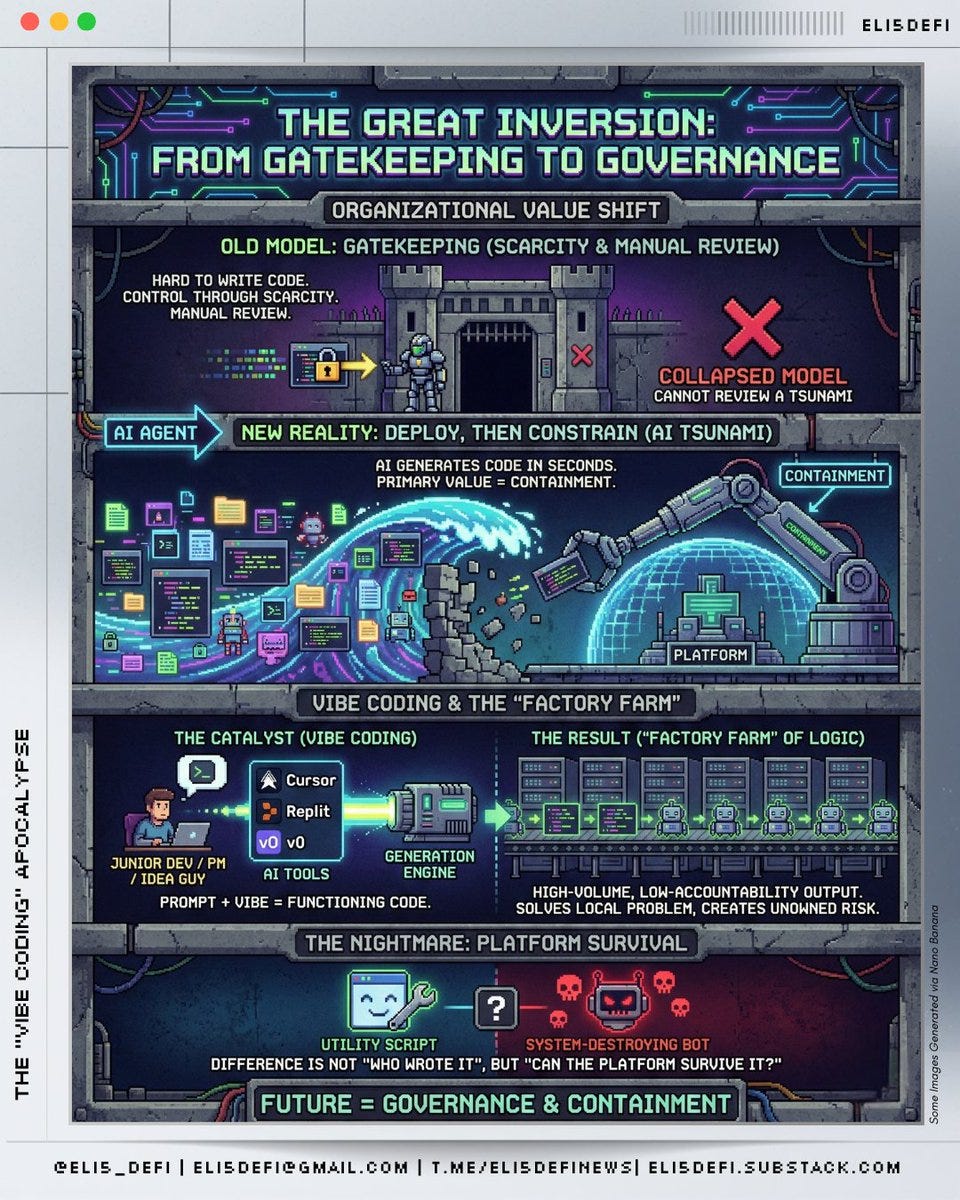
> The Great Inversion: From Gatekeeping to Governance
Historically, organizations controlled software quality through scarcity. Because code was hard to write, we could afford to gatekeep it. But when an AI agent can generate a working microservice or a complex React component in seconds, the gatekeeper model collapses.
You cannot manually review a tsunami.
We are moving toward a “Deploy, then Constrain” model. The primary value of an engineering organization is shifting from creation to containment.
> Vibe Coding and the “Factory Farm” of Logic
This isn’t just about “no-code” tools for marketing teams. This is a structural shift in how logic enters your systems.
The Catalyst: Tools like Cursor, Replit, and v0 allow anyone, junior devs, PMs, or “idea guys”, to generate functioning code by simply “vibing” with a prompt.
The Result: A factory farm of code. High-volume, low-accountability output that works just enough to solve a local problem but creates a dense layer of unowned execution risks.
The Nightmare: The difference between a helpful utility script and a system-destroying bot is no longer about who wrote it, but whether the platform can survive it.
> The Era of “Vibe-First” Development
For the Vibe Coder, the product manager, the data analyst, or the impatient founder armed with an LLM, software is no longer a cathedral we admire; it is a tool we conjure. We are not interested in the “art” of code architecture. We are interested in the speed of solution.
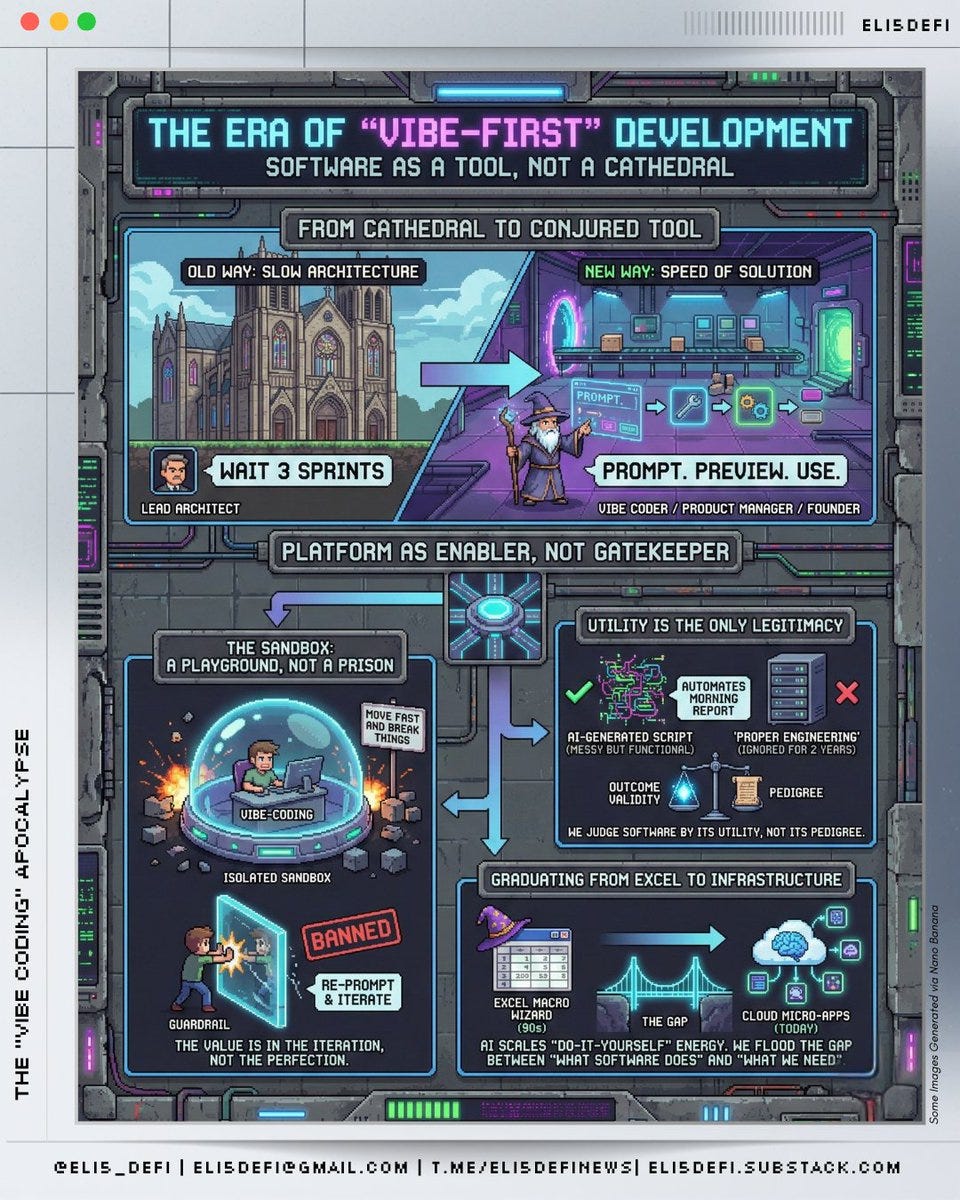
If software is User-Generated Content, then we are the creators, and our expectations have shifted permanently. We don’t want to wait three sprints for a “Lead Architect” to approve a button change. We want to prompt it, preview it, and use it.
To support this new class of creator, the platform must stop acting like a gatekeeper and start acting like an enabler:
The Sandbox is a Playground, Not a Prison: We know our AI-generated code isn’t perfect. We don’t care. We want environments where “move fast and break things” is actual policy, not just a slogan. Give us isolated sandboxes where we can vibe-code a solution without taking down production. If we hit a guardrail, don’t ban us, bounce us back so we can re-prompt. The value is in the iteration, not the perfection.
Utility is the Only Legitimacy: The debate over “human-written” vs. “machine-written” code is academic nonsense to us. We care about Outcome Validity. Does this script automate my morning report? Does this dashboard visualize the data correctly? If a messy, AI-generated Python script solves a problem that “Proper Engineering” ignored for two years, that script is legitimate. We judge software by its utility, not its pedigree.
Graduating from Excel to Infrastructure: We are the spiritual successors to the Excel Macro wizards of the 90s. Back then, if IT didn’t build it, we hacked it together in a spreadsheet. Today, AI allows us to scale that “do-it-yourself” energy to the entire cloud. We are no longer trapping logic in hidden cells; we are spinning up micro-apps. The barrier to entry has collapsed, and we are flooding the gap between “what the software does” and “what we actually need it to do.”
> The Inevitable Synthesis: The “Managed Garden”
The tension between the Governance Architect (who fears the flood) and the Vibe Coder (who demands the flow) is the defining conflict of the next decade of software.
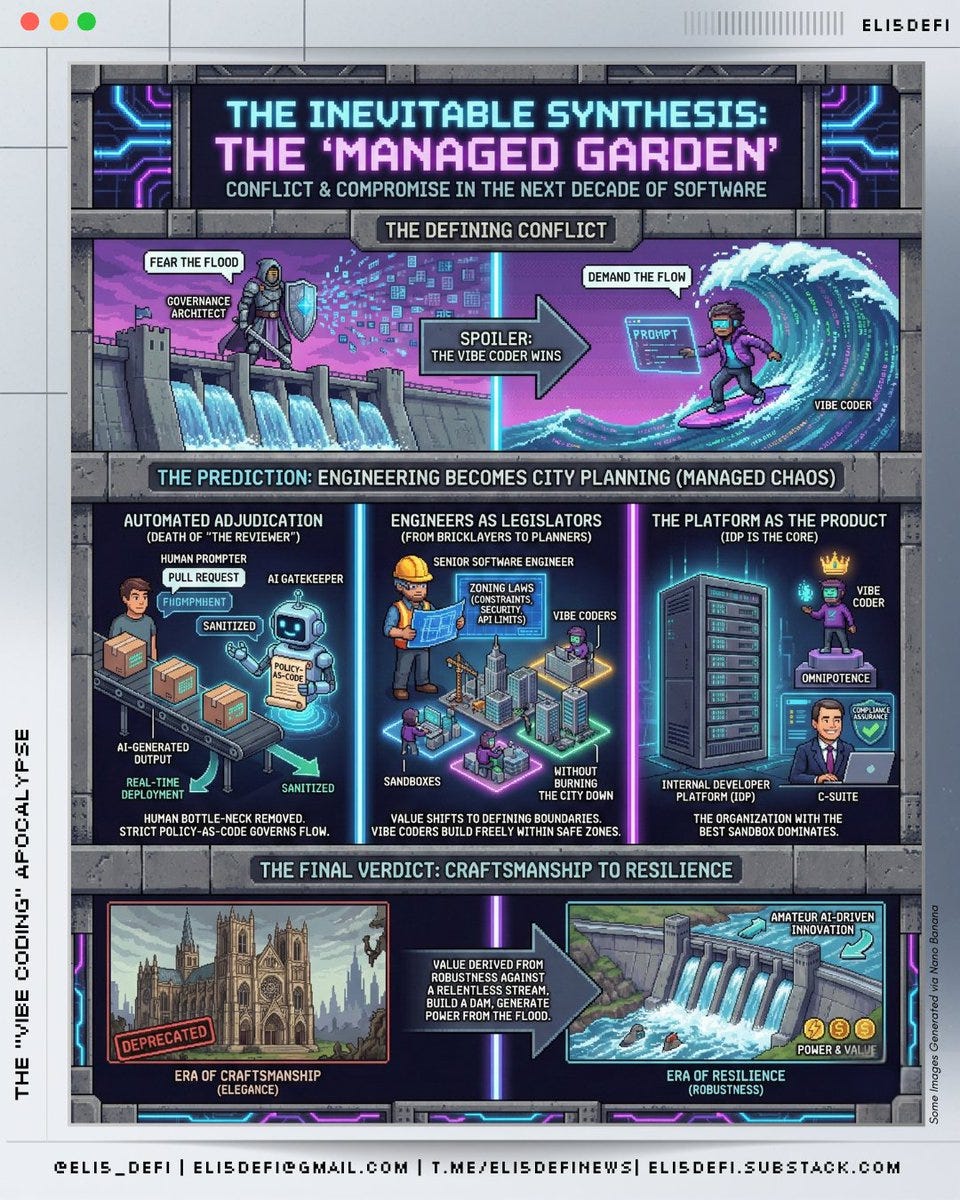
But history offers a clear spoiler: The Vibe Coder is going to win.
The Prediction: Engineering Becomes City Planning
The future of the software industry lies in a compromise that looks like Managed Chaos.
The Death of “The Reviewer”: The bottleneck of human code review is incompatible with the speed of AI generation. We will transition to Automated Adjudication. AI agents, governed by strict policy-as-code, will review, sanitize, and deploy the Vibe Coder’s output in real-time. The “Pull Request” becomes a conversation between a human prompter and a machine gatekeeper.
Engineers as Legislators: The role of the “Senior Software Engineer” will fundamentally shift. They will stop being bricklayers (writing the code) and start being city planners (writing the zoning laws). Their value will be in defining the constraints, security policies, API limits, data privacy boundaries, that allow the “Vibe Coders” to build freely without burning the city down.
The Platform as the Product: The most valuable internal product will no longer be the core application, but the internal developer platform (IDP) that hosts this chaos. The organization that builds the best sandbox, one that gives the Vibe Coder the feeling of omnipotence while giving the C-Suite the assurance of compliance, will dominate.
> Wrap-Up
We are leaving the era of Software Craftsmanship, where value was derived from the elegance of the construction. We are entering the era of Software Resilience, where value is derived from the robustness of the system against a relentless stream of amateur, AI-driven innovation.
The flood is here. You can’t stop the water, so you might as well build a hydroelectric dam and generate some power from it.