Why Pendle & RWA Will Win?

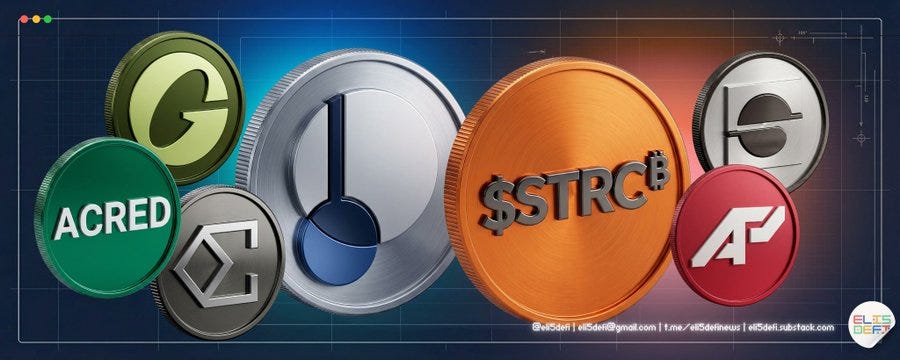
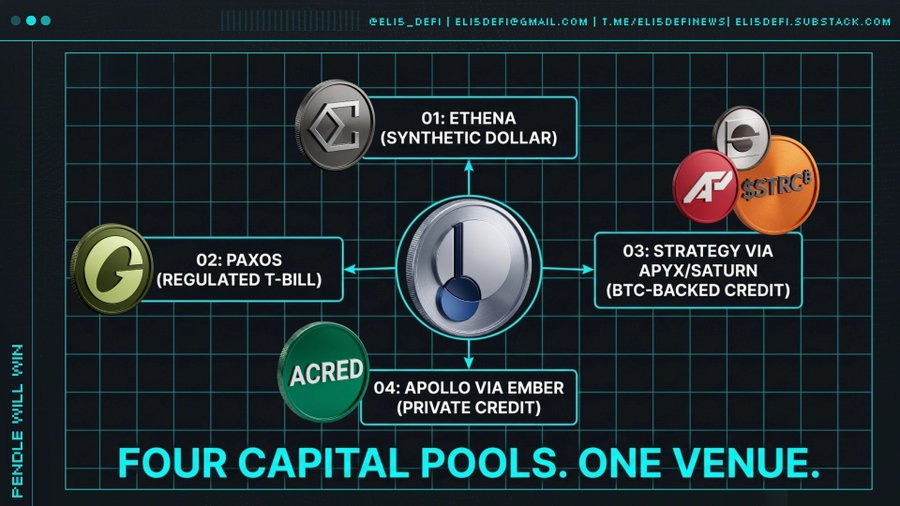
Apollo’s private credit. Paxos’ regulated stablecoin. Strategy’s Bitcoin-backed preferred stock. Ethena’s synthetic dollar.
Four of the most consequential yield sources in crypto now route through the same PT/YT mechanism.
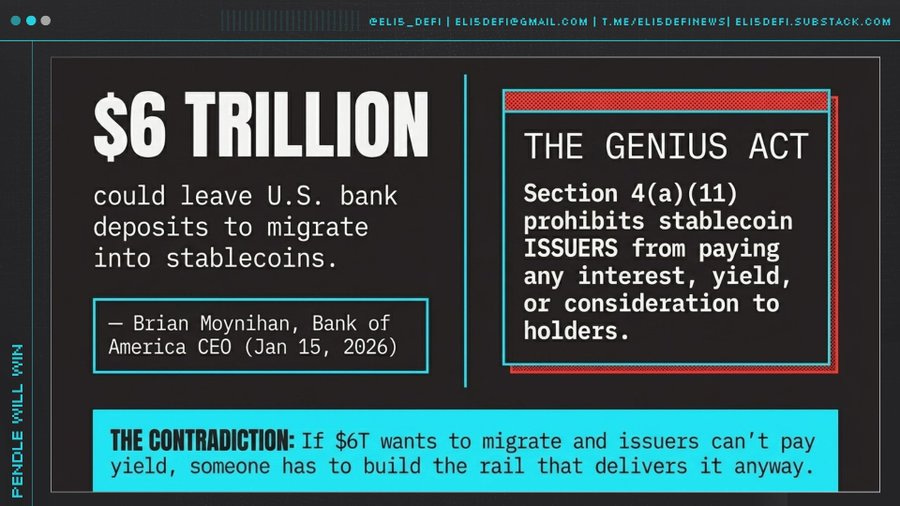
Bank of America’s CEO told Congress in January that $6 trillion in U.S. deposits could migrate into stablecoins. The banking lobby wants interest-bearing stablecoins banned.
The GENIUS Act already prohibits issuers from paying yield directly. The Senate’s current crypto market structure bill would extend that ban to exchanges.
The same months these fights were playing out, Apollo, Paxos, Strategy, and Ethena were all quietly plumbing their yield products into Pendle.
The protocol has become the default fixed-rate venue for institutional-grade yield in DeFi. Not because it ran a marketing campaign. Because PT/YT is the only mechanism that lets an issuer deliver yield onchain without the issuer legally “paying” it.
This is what a DeFi primitive looks like when it captures a rail.
The RWA tailwind is structural, not narrative
A few data points to frame what’s actually happening:
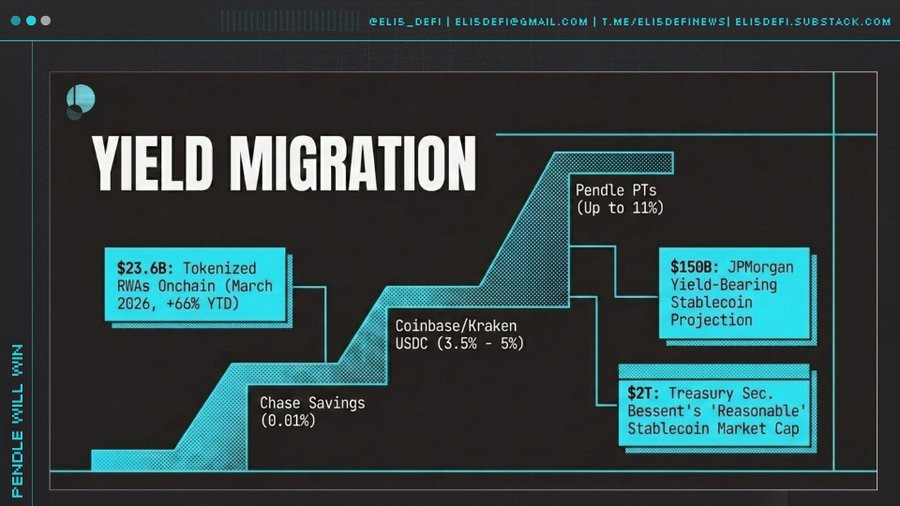
Tokenized RWAs onchain hit $23.6B in March 2026, up 66% year-to-date
Tokenized RWAs onchain hit $23.6B in March 2026, up 66% year-to-date
JPMorgan projects yield-bearing stablecoins alone could reach $150B in market cap
Treasury Secretary Bessent called $2T in total stablecoin cap “very reasonable”
BofA CEO Brian Moynihan, citing Treasury Department studies, warned that up to 30-35% of U.S. commercial bank deposits, roughly $6T, could shift onchain if rules allow
Current stablecoin market cap sits at $310B. Roughly 85% of it pays zero yield.
The gap between a 0.01% Chase savings APY and the 3.5-5% USDC rewards from Coinbase and Kraken is exactly the spread that’s pulled $23B of RWA value onchain in two years.
The gap between those exchange rates and the 11% available through Pendle PTs is what’s about to pull the next wave.
The regulatory arbitrage argument
The GENIUS Act (signed July 2025): Section 4(a)(11) prohibits permitted payment stablecoin issuers from paying any form of interest, yield, tokens, or other consideration to holders solely for holding the stablecoin.
The word that matters: issuers. The law applies to Paxos. Not to Pendle.
The yield gap: Chase pays 0.01% APY. Kraken and Coinbase pay 3.5-5% on USDC. Apyx’s apyUSD and Saturn’s sUSDat, routed through Pendle, deliver up to 11%. The whole reason these products attract capital is that onchain yield is an order of magnitude better than bank deposit rates.
The CLARITY Act / Senate market structure bill: The draft released January 9, 2026 would extend the interest ban to “digital asset service providers.” That language could theoretically hit centralized exchanges offering passive rewards. Coinbase pulled its support over this provision. The Senate markup has been repeatedly postponed.
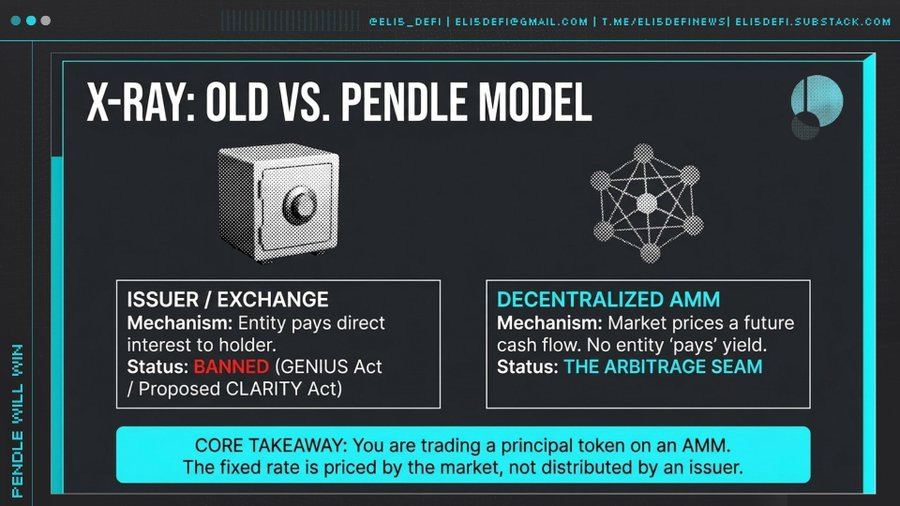
Why Pendle’s design survives this: When a user buys PT-USDG or PT-apxUSD, they’re not receiving interest from Paxos or Apyx. They’re trading a principal token on an AMM. The fixed rate is priced by the decentralized market, not paid by an entity. No issuer is handing yield to a holder. No service provider is distributing rewards. A market is pricing a future cash flow.
If Congress bans exchange-level rewards, Pendle’s permissionless AMM model becomes the primary viable venue.
Ethena as the template
Before Apollo, before Paxos, before Strategy’s preferred stock, there was Ethena.
The Pendle-Ethena relationship is the most significant protocol-to-protocol partnership in DeFi to date.
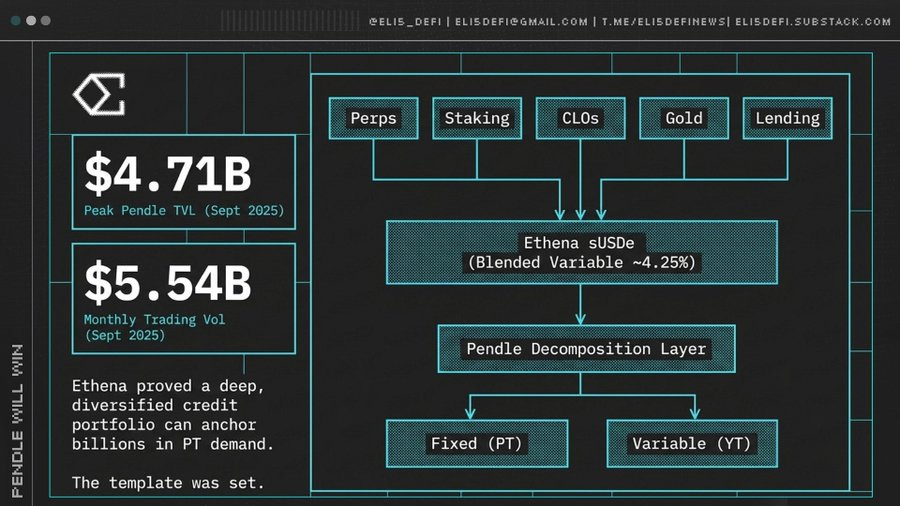
Ethena’s sUSDe became Pendle’s single largest TVL contributor ever. TVL hit $4.71B in September 2025
Monthly trading volume on Ethena pools reached $5.54B in September 2025, driven by the Sats airdrop campaign and PT-USDe looping into Aave collateral
Peak swap fees: $3.6M in April 2024, during the early launch frenzy when implied yields were extremely volatile
Ethena’s total TVL crossed $10B partly because Pendle PTs became the fixed-rate exit for yield-seeking capital
Why this matters for the RWA story?
Ethena is diversifying its backing away from pure funding rates into a broader credit mix. As that happens, the implied yield on PT-sUSDe starts to reflect a blended signal, crypto funding rates, CLO and corporate bond spreads, institutional lending rates, gold funding.
Fixed-income traders recognize this instinctively. It’s an interest rate swap on a diversified credit portfolio, priced by a permissionless market.
The Ethena template proved something important.
A yield source deep enough and structured well enough can anchor billions of dollars of PT demand. That template is now being run back four more times, with bigger originators.
The Paxos moment: USDG
In March 2026, Pendle integrated USDG, Paxos’ Global Dollar stablecoin.
That was Pendle’s first direct integration with a regulated stablecoin issuer putting its own T-bill-backed product onchain.
USDG’s credentials are the cleanest in the market:
Issued by Paxos Digital Singapore, a Major Payments Institution supervised by the Monetary Authority of Singapore
Fully compliant with both MAS guidelines and the EU’s MiCA framework
~$2.14B market cap, reserves managed by DBS Bank, Standard Chartered, Dreyfus, and Banking Circle
Over 90 Global Dollar Network partners including Kraken, Robinhood, OKX, Mastercard, Worldpay, Galaxy, Anchorage Digital, and AMINA Bank
Day one on Pendle, USDG pulled $46M TVL. Within weeks it crossed $120M. Paxos and Global Dollar Network more than doubled the incentives, from $150K to $390K, once they saw the curve forming.
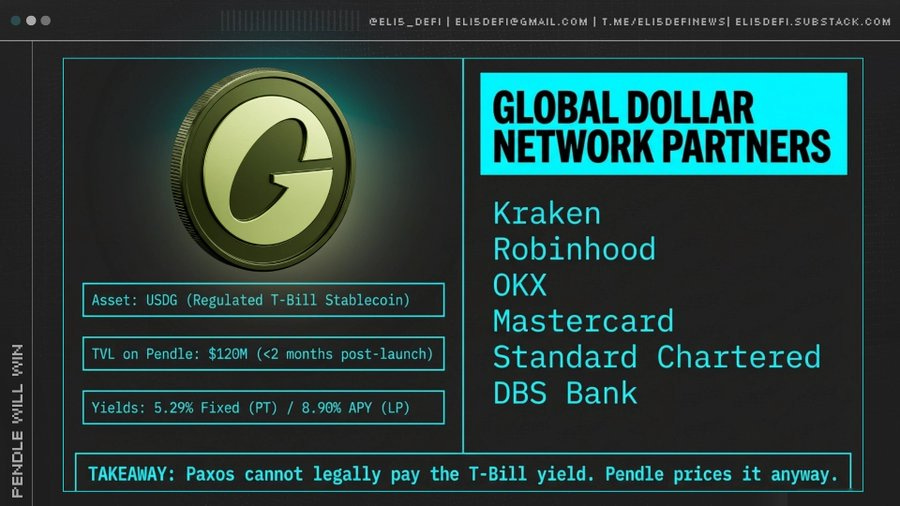
The mechanics are the cleanest demonstration of why Pendle matters for regulated stablecoins. The pool maturing May 14, 2026 lets a holder either buy PT-USDG to lock in 5.29% fixed through the decentralized AMM, or provide liquidity for up to 8.90% APY.
USDG itself is Treasury-backed. The yield exists. Paxos cannot legally pay it to holders. Pendle prices it anyway.
Industry coverage framed it as a new benchmark for institutional fixed income in DeFi. That framing is accurate. Every regulated issuer watching USDG’s curve now has a working case study for how to put their product onchain without running afoul of the GENIUS Act.
The STRC pipeline: Apyx and Saturn
Different origin. Different risk profile. Same destination.
STRC is Strategy’s perpetual preferred stock. 11.5% annual dividend, paid monthly in cash, rate has held steady since March 2026 after seven consecutive monthly increases from the original 9% launch rate in July 2025.
Strategy uses STRC to fund Bitcoin purchases. The company now holds 761,000 BTC, roughly 3.6% of total supply. STRC funding accounted for 75% of Strategy’s most recent Bitcoin acquisition, up from 3% three weeks prior. On April 14, STRC recorded $1.6B in single-day trading volume.
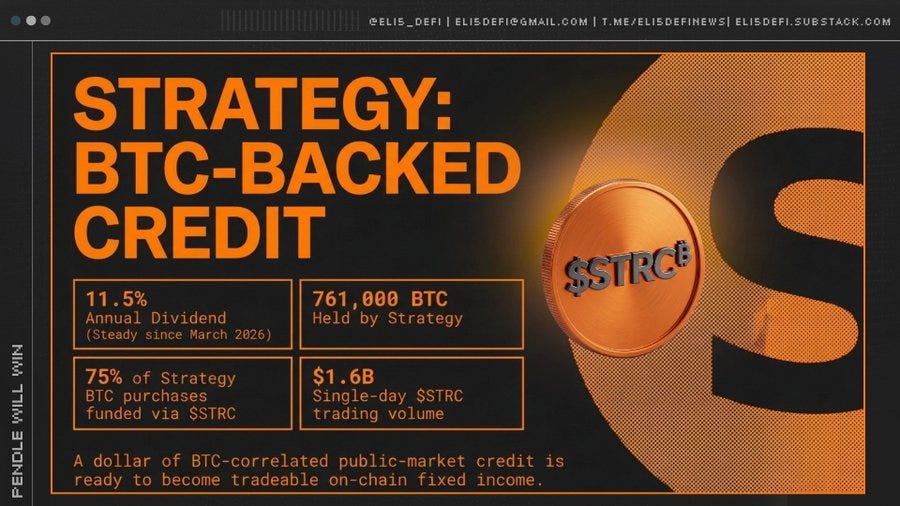
Two projects brought STRC’s yield onchain and both landed on Pendle.
Apyx is the first dividend-backed stablecoin protocol. Backed by the team behind DeFi Development Corp. (Nasdaq: DFDV), the first SOL DAT. The stack:
apxUSD is a synthetic non-yield-bearing dollar, collateralized by preferred equity including Strategy’s STRC (11.5%) and Strive’s SATA (12.7%)
apyUSD is the yield-bearing version. Dividends from the preferred shares flow to apyUSD holders through an appreciating exchange rate against apxUSD
288,888 STRC shares held, approximately $29M, targeting top-holder status
$300M funding round closed in under two months
104% overcollateralization, BitGo custody
The numbers on Pendle are what make this a category event. Forty-seven days from launch, Apyx’s combined Pendle TVL sits at $82.6M. The apyUSD pool alone is at $44.7M. That’s roughly $1.76M in daily average TVL accumulation for a stablecoin that didn’t exist two months ago.
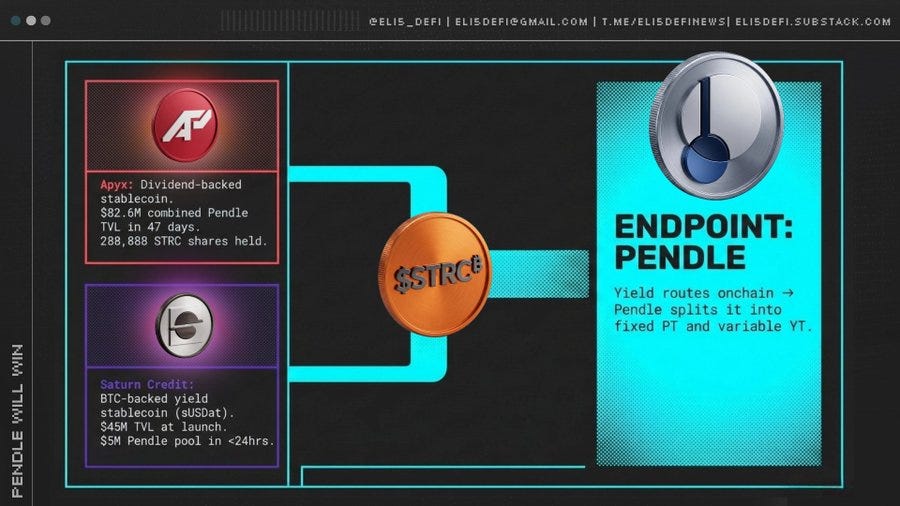
Saturn Credit runs the same thesis through a different structure. Ethereum-based, went live on public mainnet April 8, 2026 with approximately $45M in TVL at launch
USDat is the base layer, non-yielding, minted 1:1 with USDC and backed by tokenized U.S. Treasuries (100% M0 target)
sUSDat is the staked yield version. Saturn reallocates reserves from Treasuries into STRC, which distributes its ~11% APY monthly through sUSDat’s exchange rate
Yield chain: BTC → MSTR → STRC → sUSDat
Gravity Points airdrop season runs until August 8, 2026 or $500M TVL cap
Pendle’s Saturn pool hit $5M within a day of launch.
Plain-English version of the flywheel: Strategy raises dollars via STRC → buys Bitcoin → STRC pays monthly dividends funded partly by BTC performance → Apyx and Saturn hold STRC as collateral → their stablecoins route dividend yield onchain → Pendle splits that yield into fixed-rate PT and variable-rate YT markets.
A dollar of BTC-correlated public-market credit becomes a dollar of tradeable onchain fixed income. Without Pendle’s PT/YT primitive, the fixed-income leg does not exist.
Ember: Apollo on Pendle through a three-layer wrapper
The fourth pillar. This one comes through institutional private credit, and it’s the most structurally consequential of the four.
Apollo manages over $840B in assets.
Their Diversified Credit Fund (ACRED) was tokenized by Securitize in January 2025 and now lives on six chains.
Apollo Crypto, the asset manager’s crypto arm, is separately running mEVUSD, a regulated USDC-denominated yield strategy co-built with Everstake and Midas. Its stated execution stack: Aave, Morpho, and Pendle.
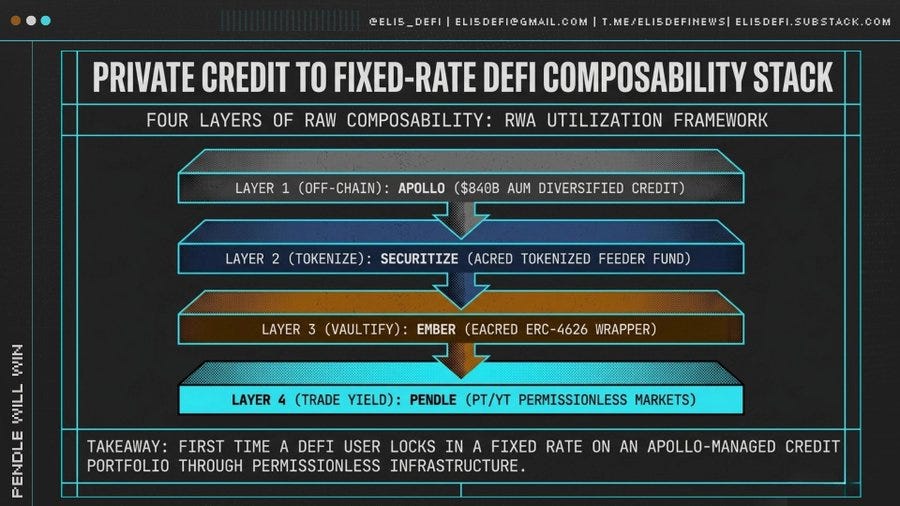
On April 14, Ember Protocol launched three Apollo-linked and basis-trade markets on Pendle in a single announcement:
eACRED is the Apollo ACRED wrapper. A Pendle user can now lock in fixed yield on a permissionless market for Apollo’s corporate direct lending, asset-backed lending, performing credit, dislocated credit, and structured credit portfolios. That’s three layers of financial engineering stacked on top of each other:Apollo’s credit fund (offchain)
Securitize’s ACRED tokenization (onchain access for accredited investors, six chains)
Ember’s vault wrapper (eACRED)
Pendle PT/YT markets (fixed-rate trading, permissionless)eEARN gives Pendle users fixed-rate access to a professionally managed stablecoin yield strategy. Structured yield as a PT. No active position management required.
eTHIRD is the Ember Third Eye Vault, currently running an opportunistic crosschain stablecoin strategy driven by MON and ENA basis trades. Yield is 20.66% APY on USDC. [13]
This is the first time a DeFi user can lock in a fixed rate on an Apollo-managed credit portfolio through permissionless infrastructure. Not a Morpho curator vault. Not a permissioned lending market. A PT with an expiry, tradeable against USDC.
Why Pendle is the connective tissue
Fixed-income products need a venue that can split principal from yield and make both independently tradeable.
Lending markets give you variable rate. Perps give you directional exposure. Neither produces fixed-rate the way a PT does.
The numbers that matter for the moat:
$5-8.9B TVL, depending on window
50-60% market share in onchain yield trading
$69.8B in cumulative fixed yield settled [17Over $40M annual protocol revenue, 80% of which funds buybacks under the sPENDLE model ▸ Citadels: the permissioned, KYC-compliant gateway designed specifically for institutional and Shariah-compliant capital
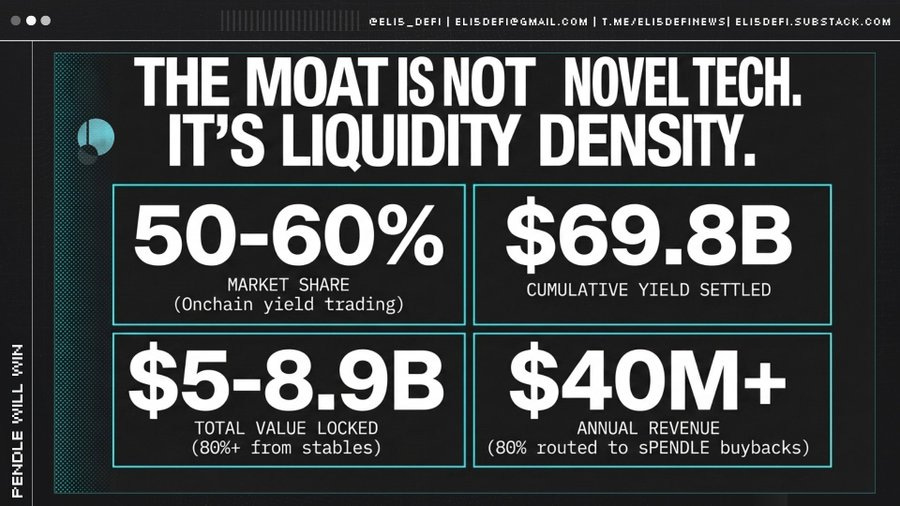
The moat is not novel tech. It’s liquidity density.
PTs are accepted as collateral on Aave, Morpho, Euler, and most major lending markets. Once an RWA issuer wraps their asset into a Pendle-compatible SY (Standardized Yield), every downstream integration comes for free. That’s why issuers line up.
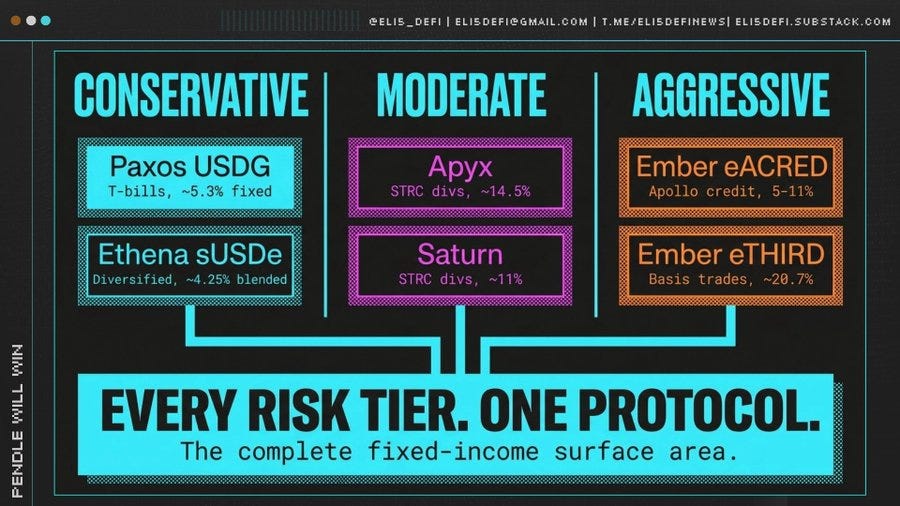
Pendle is positioned to capture the full RWA risk spectrum:
T-bills via USDG
Managed stablecoin strategies via Ember’s eEARN and Apollo Crypto’s mEVUSD
Corporate dividends via Apyx and Saturn’s STRC products
Institutional private credit via Ember’s eACRED
Synthetic dollar basis trades via Ethena’s sUSDe and Ember’s eTHIRD
No other DeFi protocol even comes close to covering that surface area.
The honest risk frame
None of this is consequence-free. A few things to keep front of mind:
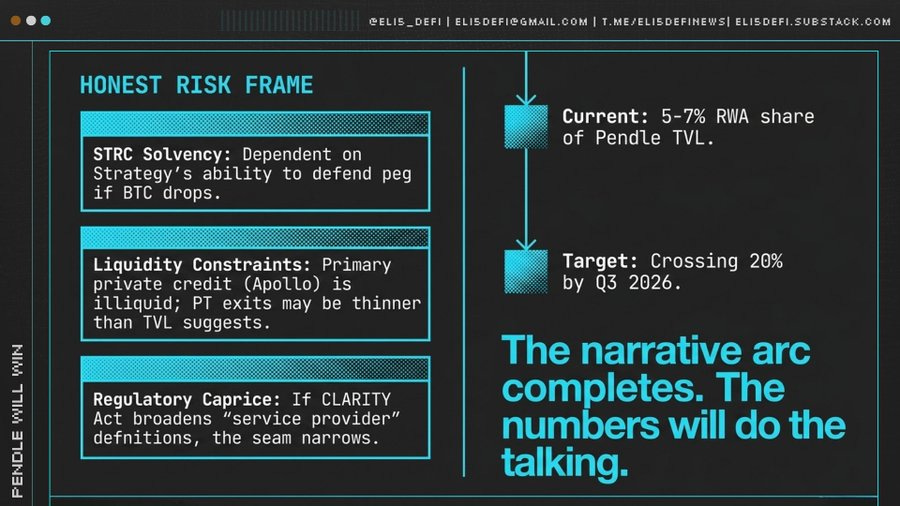
STRC is leveraged Bitcoin exposure dressed as fixed income. If BTC drops hard enough that Strategy has to raise the dividend rate to defend the $100 peg, or worse, runs into funding stress, the stress transmits down to apxUSD and sUSDat backing. The “structural obligation” of preferred dividends depends on the issuer’s solvency
Apyx’s reported 104% overcollateralization is thin. Fine at STRC’s current volatility profile. Not fine in a real drawdown
ACRED and most tokenized private credit quote 8-12% APY but have illiquid primary sides. PT liquidity on Pendle is thinner than headline numbers suggest for large exits, and secondary market NAV can dislocate from fund NAV in stress
The regulatory arbitrage works until it doesn’t. If the CLARITY Act passes and Congress defines “digital asset service provider” broadly enough to include permissionless protocols, the whole seam narrows.
Most of these RWA products are securities. Tokenized wrappers do not neutralize that. SEC action on any individual product reshapes the pipeline behind it
One thing to note is that, Ethena’s USDe peaked near 75% of Pendle TVL in September 2025. By Q1 2026, stable TVL has diversified hard:
18 different stablecoins each cleared $10M in TVL on Pendle
Non-USDe stablecoins now contribute 27%+ of stable TVL (vs.1% twelve months earlier)
Boros, Pendle’s funding-rate product launched August 2025, has grown from under 1% to roughly 10% of protocol revenue as a separate product line independent of the stablecoin loop.
Wrap-Up
Pendle’s RWA moment is not a single integration. It’s a pattern. Whenever an institutional credit product goes onchain in 2026, Pendle is where it lands for fixed-rate trading.
Saylor’s preferred stock. Apollo’s private credit. Paxos’ regulated stablecoin. Ethena’s synthetic dollar. Four different originators, four different capital pools, one venue.
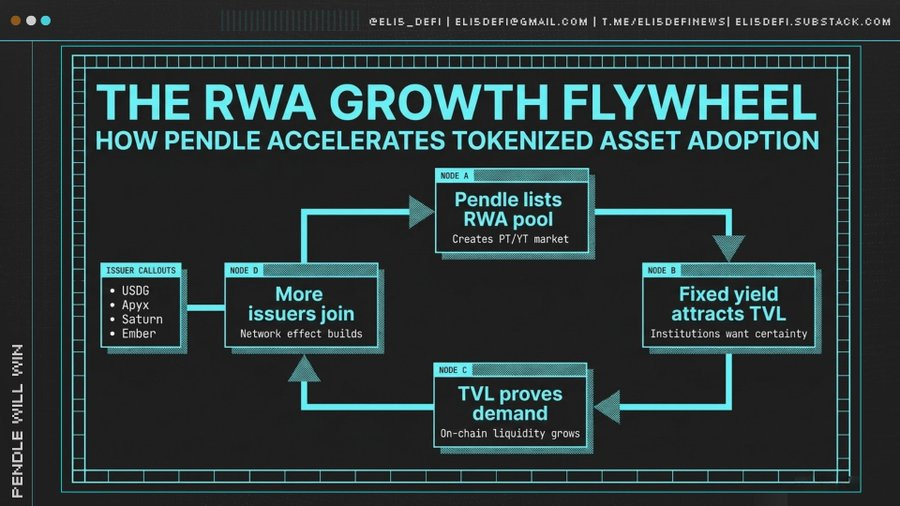
The complaint against DeFi for five years has been that it never built real fixed-income markets. This is what that market actually looks like when it shows up.
The variable to track over the next two quarters is RWA share of Pendle TVL. Current share sits around 5-7% depending on how you classify Ethena-adjacent products. If it crosses 20% by Q3 2026, the narrative arc is complete and the numbers will be doing the talking.
Pendle Must Win.
NFA. DYOR.